Three structural innovations – i) funds jointly branded by three top-tier managers, ii) a fund that mixes liquid public securities with illiquid private assets, iii) a mixed private fund with a lower redemption cap.
Structural problem of previous generation – high profile problems
The previous generation of private credit retail funds was mostly invested solely in private credit assets and allowed redemptions of up to 5% per quarter. They are currently facing high redemptions across most top-tier managers – with redemption requests above 10% for the latest quarter in most cases and above 30% for the quarter in some cases.
There is a “fragile” system at play – where investors try to get out early at signs of trouble because they worry that the best (most liquid) assets will be sold first, and investors remaining in the fund will be left with assets that are at a lower value – requiring markdowns at some point. Whether or not that is true, it creates a dynamic in which these funds can face (and have been facing) high redemptions.
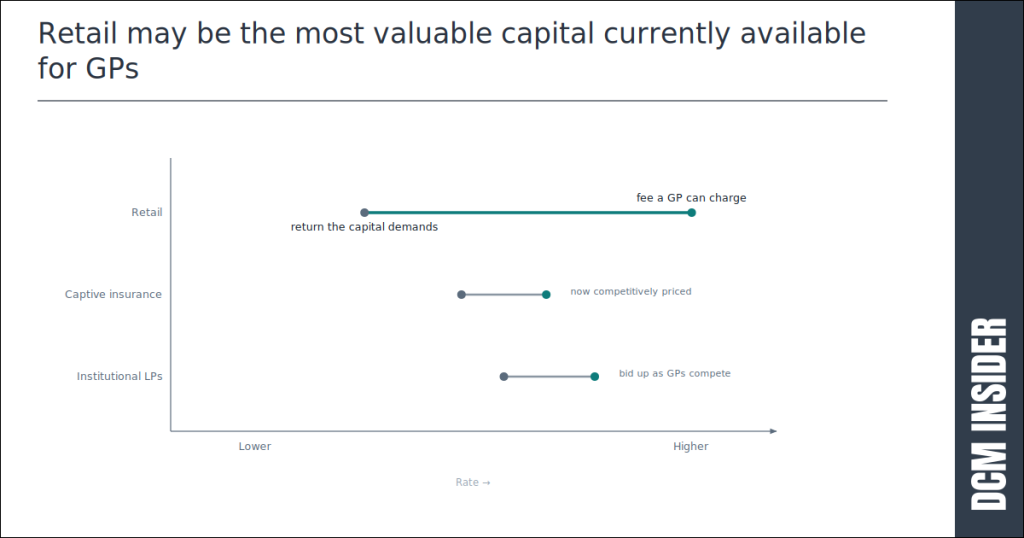
Retail offers large volumes of low cost, high fee capital to private credit firms that can figure it out
Institutional LP capital has been getting more expensive in private credit – as the market matures and GPs compete to get this capital.
There are also potential risks about ongoing ability to raise as much institutional capital because of the current round of global banking deregulation – including regulatory capital reductions – which is allowing banks to compete for business which they could not do after the 2008 regulatory capital increases. Private credit stepped in and grew rapidly at that point – but the return of banks to these markets is likely to reduce returns to below levels needed by many institutional LPs to accept the illiquidity, fees, etc of many private credit funds.
Many of the largest/most forward looking private credit funds diversified by securing captive insurance capital (like Apollo’s merger with Athene in 2022 and KKR’s acquisition of Global Atlantic in 2021) – which provides very long term capital and fee income. The issue with this now is that this market has matured and the value of captive insurance capital is now more fully reflected in its price for new money.
Retail capital is still relatively untapped and is a very large source. The argument is that it is sticky (if structured right), relatively fee/price insensitive, relatively return insensitive after invested, and highly scalable.
High net worth wealth is now around $100 trillion globally. Any percentage allocation to private credit would be significant. Adding the “mass affluent” segment (which these funds are also marketed to) adds to this.
Government policy and regulatory tailwinds
The current US government has supported increased access to private markets – with measures including allowing more investments in private assets through 401(k) and retirement plans.
The SEC also changed guidance that effectively prevented closed-end funds sold to retail investors from being able to invest more than 15% of their net assets in private assets. This regulatory change may be what has allowed these new funds to be issued – with Blackstone potentially being at the front of a series of similar funds to come from other private credit managers.
Innovation one – multi-manager branding
By cobranding this between Blackstone, Wellington and Vanguard (both new funds start with the initials “WVB”) – it distances the fund from the private credit manager. By combining these three well known brands, it could create a greater sense of safety for new retail investors.
If there is an issue in the future – as there has been with recent redemptions – it could also distance the fund from the private credit manager to some degree and reduce the “brand contagion” risk that private credit managers have recently been working to contain.
Innovation two – one of the funds is mixed public and private assets
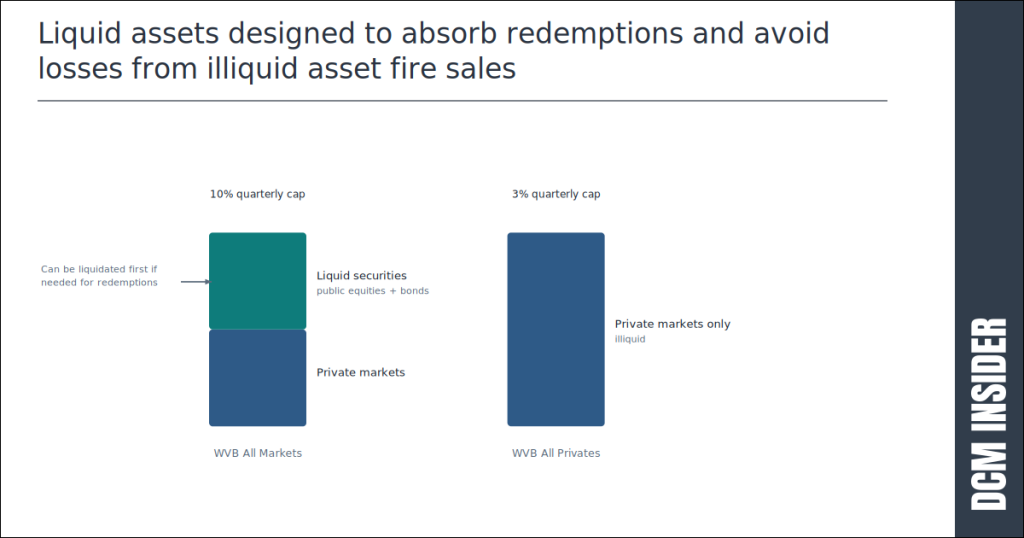
The first of the two launched funds is the “WVB All Markets Fund” – which combines public equities, public fixed income, and private markets. Wellington brings the public equities management expertise, Vanguard brings the public active fixed income expertise, and Blackstone brings the private markets platform.
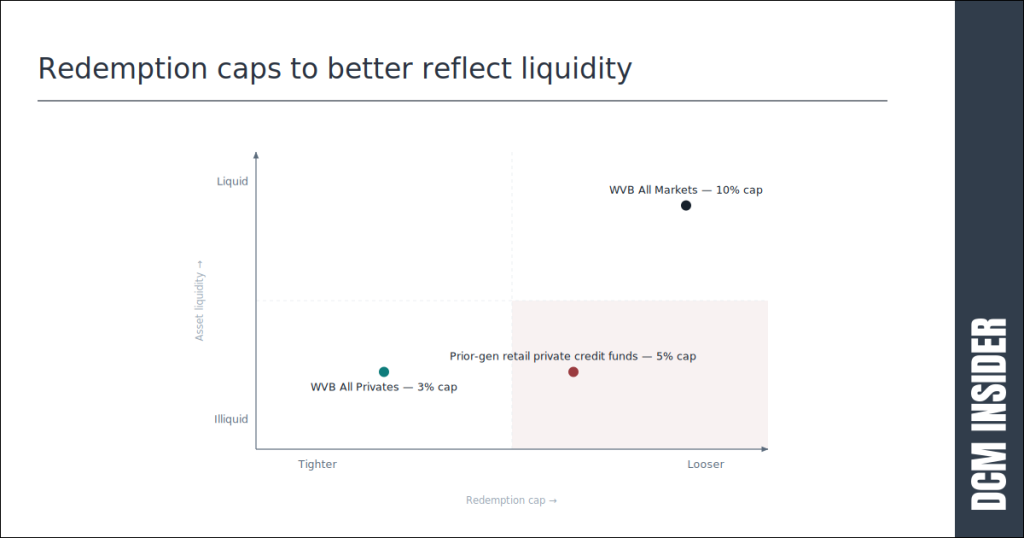
This fund has a 10% quarterly redemption limit.
Innovation three – the other of the funds is mixed private assets with a lower redemption cap
The second of the two launched funds is the “WVB Blackstone All Privates Fund” – which is a mix of private assets managed by Blackstone. It includes private credit, private equity, private infrastructure, and private real estate.
This fund has a 3% quarterly redemption limit.
This potentially makes a big difference – as a 5% a quarter cap (as most prior generation retail private credit funds allow) is 18.5% a year. But a 3% quarterly cap is only 11.5% a year. This could make a big difference to prices achieved/discounts that need to be accepted when needing to sell illiquid assets.
Distribution – Merrill and Bank of America
The funds are being sold by Merrill and Bank of America Private Bank to high net worth and mass affluent customers. High net worth is often defined as $1m to $5m in liquid assets, and mass affluent as $100k to $1m in liquid assets. They expect to add more distribution partners over time.