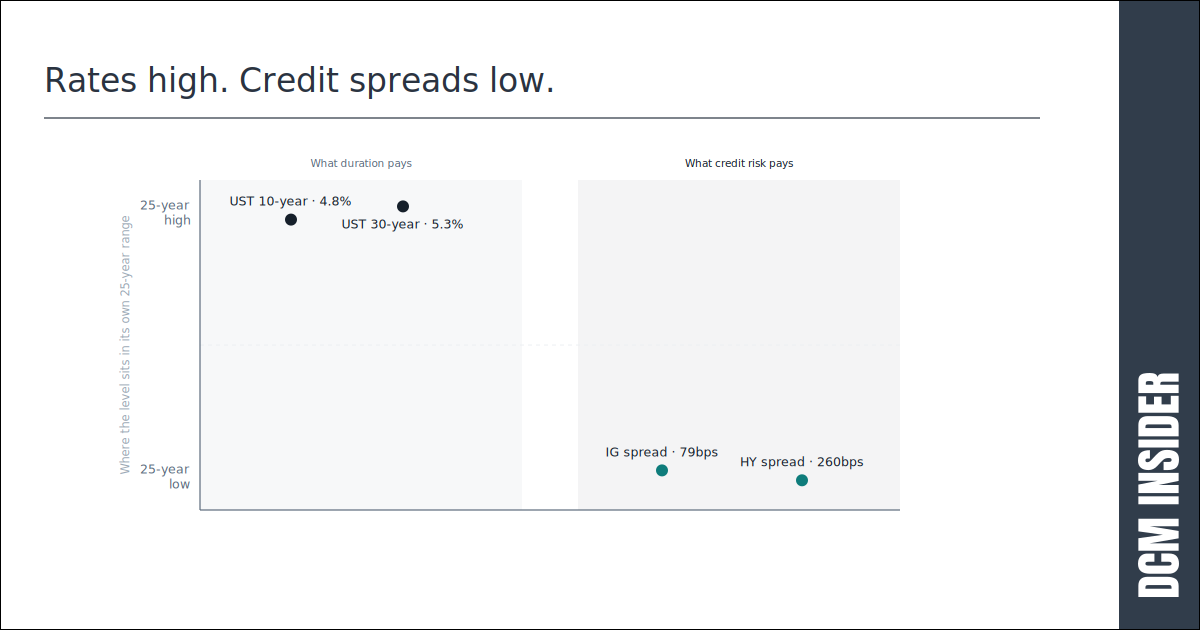
Debt markets have substantial capital to deploy, helped by interest rates that are seen as high. Credit spreads are therefore around 25-year lows and continued to tighten during the week, creating a strong market for new issuance.
The counterweight is risk: further rate increases, defaults or losses may not be fully priced in, while covenant protection is drawing more attention. With a heavy primary calendar expected after the Labor Day break, issuers and investors are looking at a strong market that could still be vulnerable to disruption.
Key market data
| Measure | Level | Weekly move / context |
|---|---|---|
| Brent crude | $89 | Down $3 on the week; the key macro figure highlighted for debt markets |
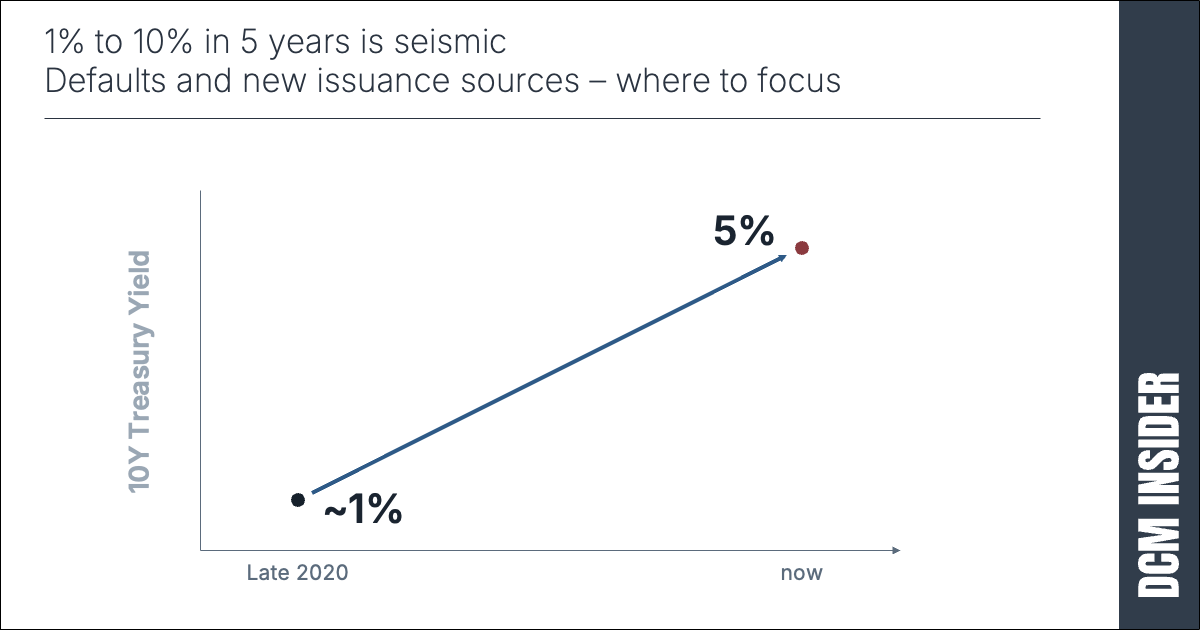
| UST 10-year | 4.8% | Around 25-year highs |
| UST 30-year | 5.3% | Around 25-year highs |
| IG spread (ICE BofA US Corporate OAS) | 79bps | Down 2bps on the week; around 25-year lows |
| HY spread (ICE BofA US HY OAS) | 260bps | Tightened 10bps on the week; around 25-year lows |
Top talking points
A large primary calendar could arrive in September
US markets were very quiet ahead of the Labor Day break, but a very large amount of issuance is expected afterwards. Issuers may seek to get ahead of competing supply — particularly AI-related financing — and a growing set of risks that could disrupt markets later in the year.
Rate expectations moved higher
Rates markets have been uncomfortable since the Federal Reserve’s 29 July decision to hold rates. Fed Chair Kevin Warsh’s Jackson Hole speech increased the market’s expectation of a September rate increase from around 40% to 65%.
Credit demand remains strong
Investment grade spreads moved from 81bps to 79bps during the week and high yield spreads from 270bps to 260bps. More money is flowing into debt capital markets as higher rates encourage fixed-income allocations and investment managers face pressure to deploy dry powder.
Investors are pushing harder on covenants
There is increasing pushback on deals that could go wrong over the next year or two, particularly where loose covenants could enable aggressive liability management exercises that transfer value from debt holders to equity holders.
Primary markets
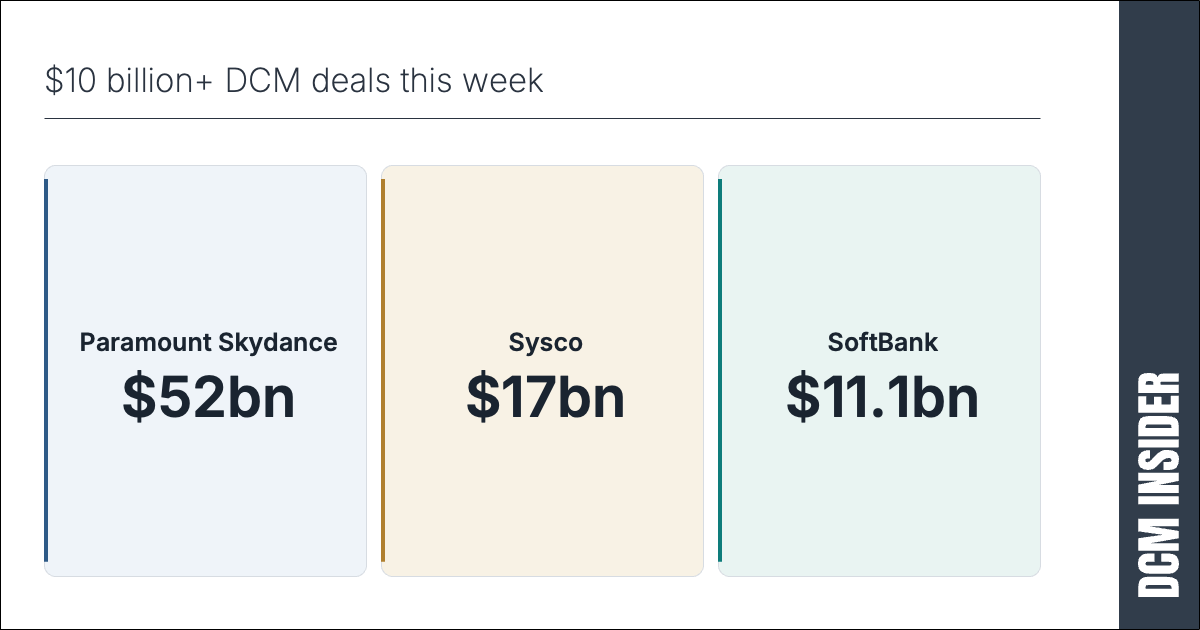
Bonds: pharmaceutical and bank supply led investment grade activity, while sovereign, SSA and emerging-market issuers were also active. SoftBank is working on a JPY 1 trillion (US$6.3 billion) Japanese retail deal and is reportedly looking at an additional $10 billion to $20 billion USD and EUR bond deal.
Private credit: Granite Asia raised over $500 million for its Pan-Asia private credit strategy, including from Asian sovereign wealth funds and banks.
Syndicated loans: Eurofiber signed a €2.2 billion deal, Ma’aden raised $1 billion, and SoftBank is reported to be working on a $10 billion syndicated loan to support AI investments.
Structured credit: Sona Asset Management priced a €404 million hybrid CLO split 70% BSL and 30% middle-market private credit loans, alongside a €900 million Italian auto ABS and $876 million Hertz car-rental ABS.
Market analysis: the combination of tight spreads, high yields, prospective September supply and increasing covenant scrutiny sets up a strong issuance market with meaningful disruption risk.
Distressed and stressed
Braskem secured 39% creditor support to launch a 90-day out-of-court restructuring attempt on $11 billion of debt. Aston Martin creditors filed for discovery as part of a challenge to the company’s dropdown financing with HPS, while Logan Group received Hong Kong court approval for its debt restructuring plan.
What to watch this week
- Middle East developments: these could pick up again.
- Payrolls data on Friday: rate expectations remain sensitive to data.
- Broadcom results on Wednesday: after strong NVIDIA results improved conditions for AI debt issuance, similarly strong Broadcom results could make the market more receptive to coming AI deals and increase prospective supply.
Quotes of the week
“The thing about market measures of inflation expectations in economic history is that they tend to look strong and durable until they don’t. Those expectations are not pushed around easily, and right now they are well anchored. But they must be closely minded. It’s the Fed’s job to make sure that inflation expectations do not get unanchored.”
Kevin Warsh, Chairman, Federal Reserve, in his Jackson Hole speech
“The AI infrastructure buildout is at full steam”
Jensen Huang, NVIDIA CEO