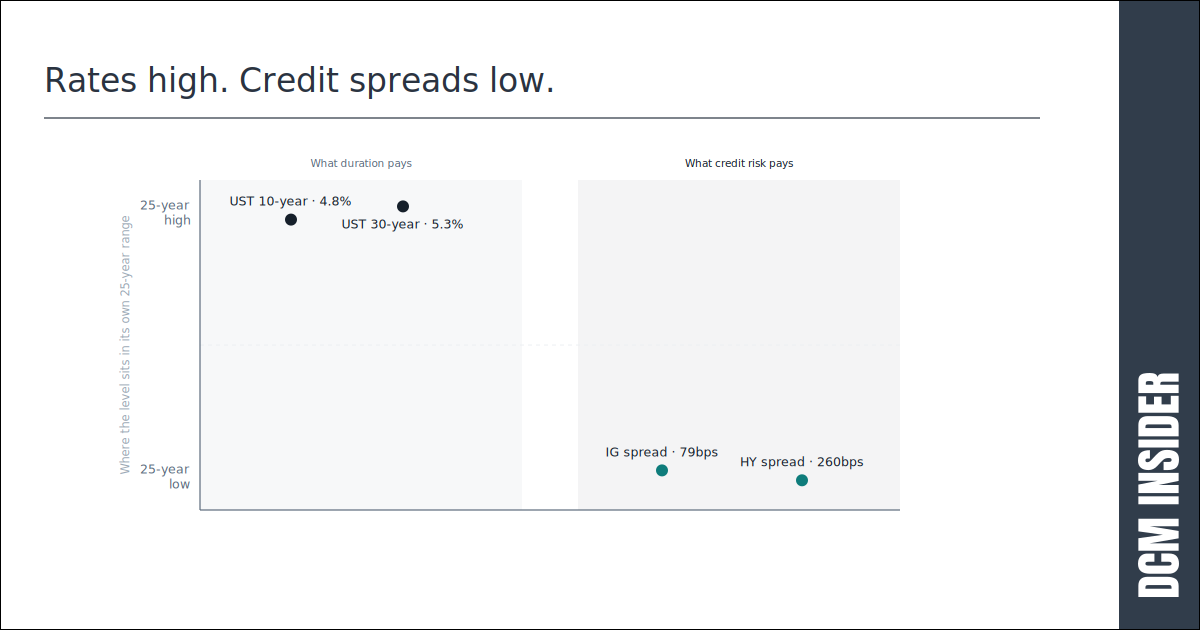
Long-term interest rates remain close to their highest levels in roughly 25 years, with the 10-year US Treasury yield at 4.7% and the 30-year at 5.2%. The week’s market picture points to a potentially higher long-term rate environment shaped by heavy AI investment, tariffs, an ageing workforce and substantial government financing needs.
The US Treasury announced an increase in buybacks of 10-year and 30-year bonds. That intervention may affect the pace and positioning of speculative moves in yields, but the underlying rate level may remain elevated if it is being driven by those broader fundamentals. Similar pressure is visible across the UK, Europe, Japan and Australia.
AI credit is becoming a major source of capital demand
AI-related financing continues to broaden across markets. Alphabet raised AUD 5.5 billion, equivalent to US$4 billion, in the Australian-dollar Kangaroo market in the largest Australian-dollar corporate bond deal to date. The transaction takes Alphabet’s 2026 issuance above $80 billion so far.
Broadcom is reportedly looking at a $60 billion to $100 billion private-credit financing for Anthropic and other AI providers. SoftBank plans to issue JPY 1 trillion, equivalent to US$6.3 billion, in retail bonds including for AI investment. Data-centre operator QTS raised $3.9 billion to fund a data centre for Microsoft, alongside a $5.75 billion convertible bond deal from AI cloud provider Nebius.
The possibility of higher long-term rates, and the smaller risk of a disorderly or closed period in long-dated markets, may encourage AI issuers to bring forward financing where possible. Locking in long-term funding before competitors could face a more difficult market is therefore emerging as a potentially significant strategic consideration for hyperscalers.
Inflation risk keeps the policy path difficult
The Federal Reserve is balancing some signs of economic easing against continuing inflation risks. Employment data and consumer spending at Walmart were weaker than expected, while Brent crude remained at $92 and the Iran conflict leaves open the possibility of a further oil-price shock.
At the same time, large-scale AI capital expenditure could create additional competition for resources. That combination makes rate-setting more difficult and increases the risk of a policy error that produces a more persistent inflation outcome.
“There’s a competition for capital happening from government financing”Alberto Musalem, President of the Federal Reserve Bank of St. Louis
Bond demand remains strong despite high yields
High absolute yields continue to attract money into bonds even as long-term government rates remain elevated. Investment-grade spreads are at 81 basis points and US high-yield spreads at 270 basis points, both around 25-year lows.
That combination is supporting primary markets: issuers have strong demand for debt while still facing an incentive to lock in financing before any later dislocation.
What to watch
- NVIDIA Q2 earnings: increasingly important for debt markets as a larger share of issuance becomes AI-related. Strong earnings could support another wave of AI financing after Labor Day on 7 September.
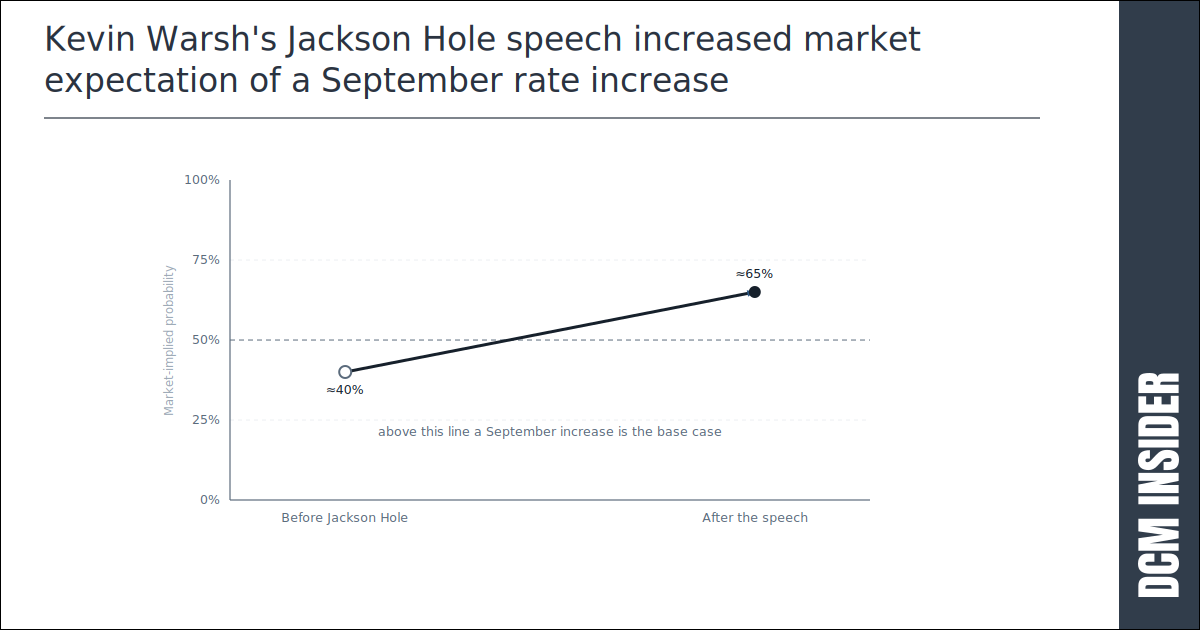
- Fed Chair Kevin Warsh at Jackson Hole on 28 August: investors remain uncertain about the path of the Fed, leaving market consensus fragile and rates volatility a key risk.
- Oil prices: escalation around the Strait of Hormuz ahead of the midterm elections could have significant short-term effects on rates.
Related coverage
See the weekly DCM Insider market overview for 24 August 2026.