What
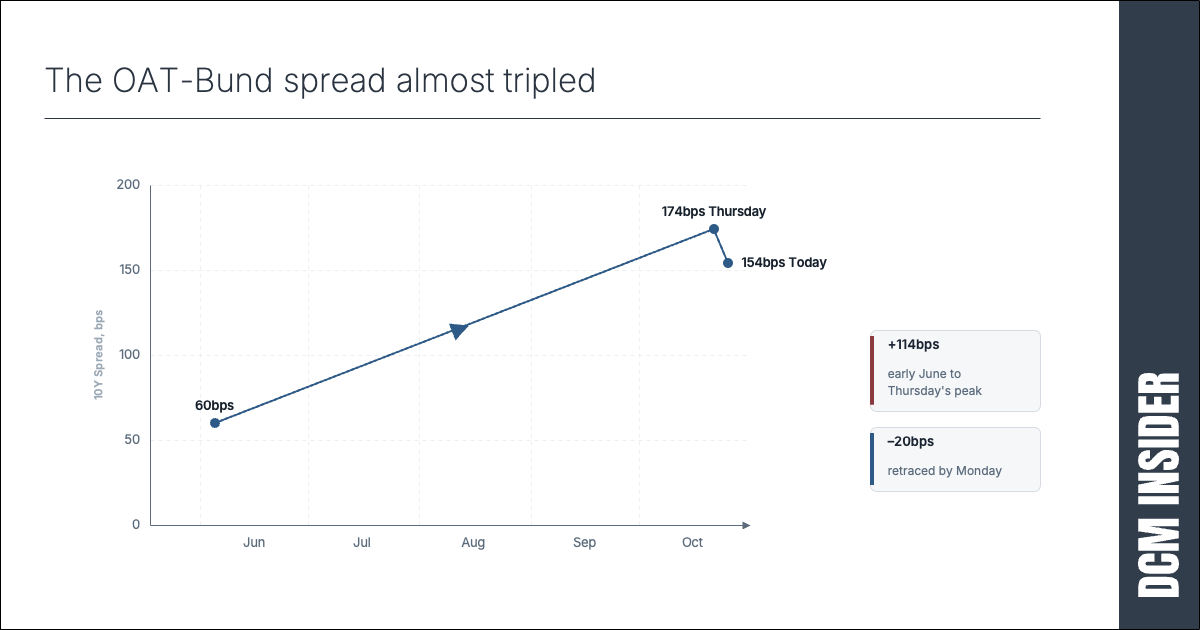
The French vs German government bond spread has quickly widened from around 60bps in June to 174bps on Thursday (and back down to 154bps today).
For historical context, this was close to flat before the 2008 crisis, around 35bps for much of the time since then, and has risen fairly steadily from around 35bps in 2021 to 80bps late last year. It reduced again at the end of last year.
The current increase (60bps to 174bps) is news because of its magnitude and speed.
Why – fundamentals
Markets are worried about government debt.
Current – Debt-to-GDP is 120% and deficit was 5% of GDP.
Future – Uncertain politics worry markets. There are concerns that if there is a change in leadership/direction – there is a chance that this results in higher debt. [Explain this more – what are the scenarios – who might get elected and what might they do that could affect debt – and why do we think that?]. Even if the “best guess” on the future path of debt does not change, a fatter left tail can lead to a sell-off. The recent civil unrest increases investor uncertainty perception on who will be elected and what the electorate asks of them to promise.
Can’t inflate it away – As France uses the Euro, it does not have the ability to choose to inflate away its debt in the same way that countries that fully, independently control their debt issuance currency can.
Why – market dynamics
There is a chance that market dynamics accelerated the move.
Foreign ownership – This could partly be because a lot of French government bonds are held by foreign investors (over 50%). This may increase the speed of selling when it looks like there is something uncertain – or even just if there might be upcoming price volatility.
Fast-money – Trading bets (by humans or algorithms) might increase volatility.