This top-tier model being made freely available to use changes the “stories” we use about how the future will unfold for AI providers
What happened
Moonshot AI (a Chinese AI company backed by Alibaba) released Kimi K3 – a top tier model which competes with Anthropic, OpenAI and Google’s top models – beating them in some performance tests (even beating Fable in a frontend development benchmark), and coming close in others.
The model is “open-weights” – which means that Moonshot AI will release the data that you need to run the model on your own computers – and that you can do this for free. It uses a lot of computer processing capacity, so that of course still has costs if you run it yourself.
Moonshot AI also offers to run the model for you (the same way that you use AI models from Anthropic, OpenAI, Google, etc.) at a much lower cost than other top-tier models – reported to be a 50% to 80% saving.
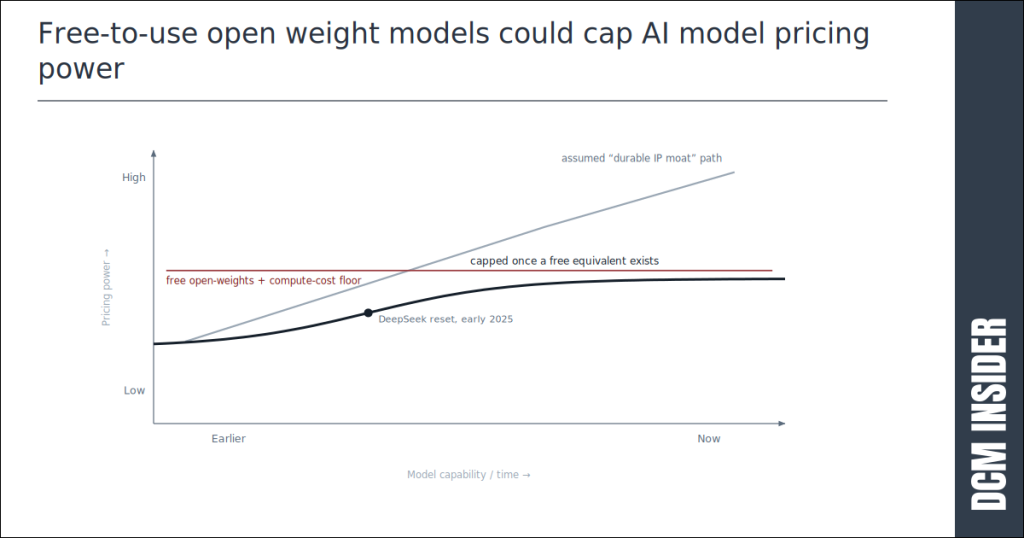
This creates significant new competition for other top-tier model providers. Other model providers are likely to respond by reducing their pricing – as we effectively saw happen when DeepSeek launched (similar, top-tier surprise release at much lower costs) at the beginning of 2025.
Re-assessing pricing power and cashflows
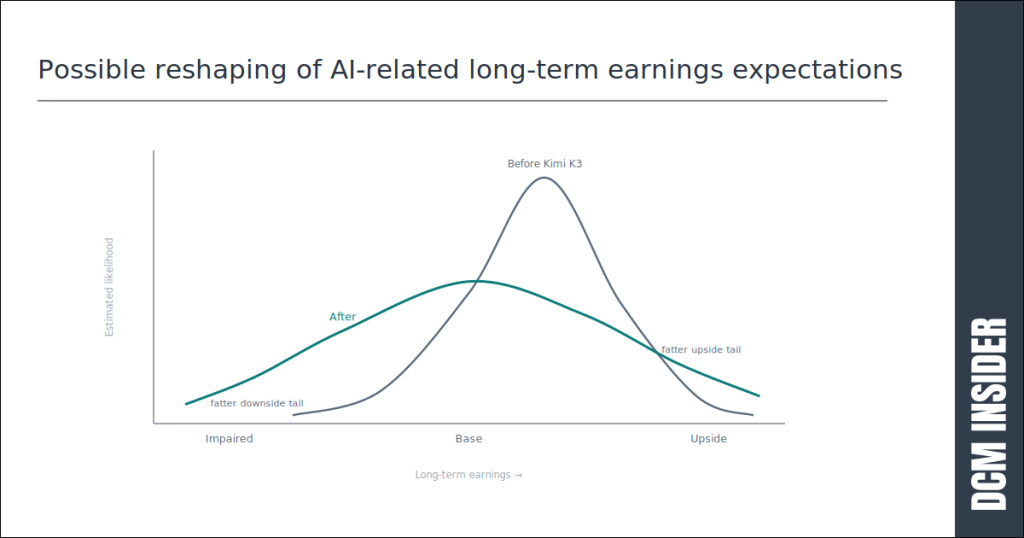
AI-infrastructure credit is based on the “stories” we project for how the future will unfold – and probabilities we attach to these. The release, the capability, and the free-to-use (“open weights”) nature of Kimi K3 were a surprise – and are likely to change some of these stories and the probability distribution of their materialisation and so outcomes. This is particularly important given the long (30+ year) maturities of some bonds.
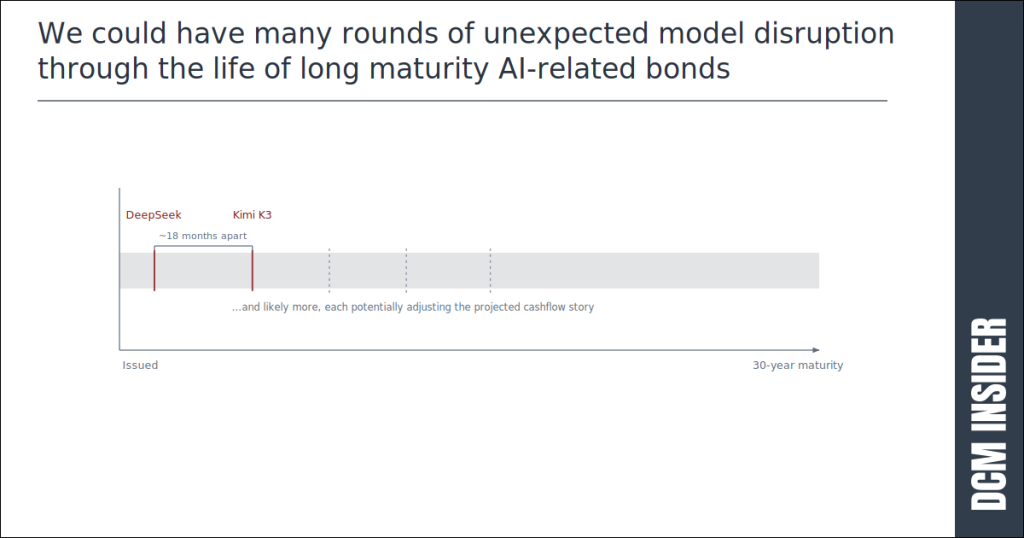
Complex, interrelated effects – possibly even materially credit positive in some scenarios
There are a number of changes that could come from this. First is that it might change future pricing power – and so cashflows. Others include the perceived risk of new frontier-level model types being developed, international competition effects – including political and regulatory effects, and effects of potentially increased data center/hardware demand with lower model costs. We look at a few of these briefly here.
First level – possible changes to pricing power assumptions
An assumption has been that by investing in developing AI models now, that R&D will produce data and IP that will be a highly valuable, cashflow generating asset for a long time. This may be/is likely to still be the case – but the development and release of this open-weights model (where the cost is your computing cost without a charge for model use) opens the door to the possibility that it might not be the case.
There might also be concerns around model training data and model biases, etc. from Kimi K3 (founded or unfounded) – which may limit its use. But the counterarguments for that are that, at enough of a cost difference, companies are still likely to use it in some cases where those things do not matter. Another counterargument is that if Moonshot AI built this model, it might mean that other AI model developers are able to create similar models in time (for example within the next few years).
Lower model costs mean more data center demand
By making top-tier (high compute use) AI model use cheaper – both to run Kimi K3 but also any new models that are released/lower priced models from the market leaders – demand for running these models is likely to increase. This “inference” is where data center cashflows come from – and so this may increase compute pricing and profitability/cashflows for data centers both in the near and long term.
This might be materially positive for pure data center credits.
A counter case might be if equity has been subsidising model use, and so increasing data center competition/demand between model providers – and if equity assumptions change and that reduces data center demand.
Complex second-order effects including international competition, permitting and regulation
The politics of AI is complex – with significant “pro” arguments including economic growth, scientific advancement, medical development, etc.. But there are also major political voices against AI – including worries about job losses, “runaway AI”/AI safety tail risks, environmental effects, power and water availability, land use, data center aesthetics and effects on home prices for an area, etc..
With Kimi K3 being a Chinese developed model, there is a strong political international competition argument that may change factors that have been slowing AI development. These include compute thresholds, licensing, liability, data center permitting, power and water build approvals, model approvals, etc..
This is a potentially very large factor. If this event results in a much more favourable political and regulatory environment, this may in protect some AI-infrastructure credits from some downside risks, and might create material upside (though much of this upside would likely go to equity rather than credit in this case given how low spreads are currently).
For DCM participants, the takeaway is to model the chance of model competition – and potential downside and upside cases from that
Predicting how this will pan out is difficult – but adding to the set of “stories” that could play out is likely valuable. Similarly adding that uncertainty/volatility in projections may also be helpful in effectively deploying capital.