In short:
Lower-rated credit spreads widening. Some primary markets slowing as investors start to worry about credit and issuers start to worry about higher borrowing costs. We might see a slow October – with markets potentially picking up again after midterm elections on 3rd November.
Top talking points:
- AI chip financing racing to get done – deals of over $130 billion started or reported this week: SpaceX is reportedly considering raising $40 billion of debt ($10 billion loans, $30 billion bonds) to buy NVIDIA chips – with the deal led by Apollo. Banks started syndicating $42 billion of senior secured loans that fund Broadcom chip purchases for use by Anthropic. Broadcom is reported to be looking to raise another $50 billion for Broadcom chip purchases by OpenAI. Volta is reported to be in the market with a $5 billion loan (at over 11%) to finance a data center in Norway. Some investors may be starting to build large concentrations in something new (the adoption of AI) – which can have higher “unknown unknown” risk.
- Low-rated credit spreads widening: CCC and lower spreads widened further to 12.52%. Up 0.50% on the week. This was less than 10% in July. The stressed/distressed debt universe is growing.
- OAT-Bund spreads up: French-German government bond spreads have traded up to around 140bps (10-year). This has doubled in 3 months – from 70bps at the beginning of July. There are concerns around the budget and around the presidential election next year – and their impact on bonds. Some of this move might be technical – as many high-grade government bond investors globally avoid the risk of volatility (and the circular technical effects that creates – as selling creates short-term volatility). Over 50% of French government bonds are owned by foreign investors – potentially increasing the ability/propensity to sell in the face of possible short term volatility. If hedge funds and other value investors take their place and view this pricing to be an opportunity – the spread may fall. Similarly there may be intervention to calm markets at an EU level. The risk on the other side is contagion to other markets – potentially driven by technical rather than fundamental factors. This might increase the odds of some action being taken soon to avoid this contagion risk.
Primary markets:
Primary markets slower than usual this week. Earnings blackouts ahead of Q3 results also reduced bond issuance. AI loans were active – possibly with issuers raising fast to avoid the risk of a market closure/capacity reduction/spread increases.
Public Investment Grade – Quite a few deals from foreign issuers in USD – $1.5 billion from Australian biotech firm CSL, $1.5 billion from Singapore bank DBS, $1.5 billion from Honda, $1.25 billion from Cargill, $1 billion from Deutsche Bank. In Euros – €2 billion from French industrial gas producer Air Liquide, €1 billion from German telecom tower operator DFMG, €1 billion from data center operator Digital Realty, €1 billion from PepsiCo. We expect to see more US bank issuance following their earnings announcements this week.
Public High Yield – $1.4 billion (split as $730 million and €600m) from Ticketmaster owner Live Nation, $800 million from industrial distributor Distribution Solutions Group for its take-private, $850 million from adhesives manufacturer H.B. Fuller to buy Advanced Medical Solutions.
Private credit – Fundraising is growing in opportunistic strategies – bespoke structured/special/complex solutions for corporates, stressed/rescue financing, and secondaries. There is also a continued focus on working out how to best invest HNW individual wealth. Centerbridge final closed a $4 billion opportunistic credit fund. Partners Group launched an evergreen private credit strategy for institutions and private wealth. M&G launched a long-term asset fund for UK defined-contribution pensions. Private credit manager PennantPark closed a $300 million middle-market CLO.
Syndicated loans – The market was largely AI financing and M&A bridge financing. The syndication of Broadcom’s $42 billion loan for Anthropic started on 5th October. French energy technology group Schneider Electric secured a $25 billion bridge from Morgan Stanley and Societe Generale for its acquisition of US industrial software company PTC. French telecom infrastructure services company Circet launched a €3 billion-equivalent refinancing – largely TLB. Volta is reported to be in the market with a $5 billion loan (at over 11%) to finance a data center in Norway. QatarEnergy is reported to have raised $3 billion from the “big four” state-owned Chinese commercial banks – BOC, ICBC, ABC and CCB.
Asset-backed – Data center securitization continued to grow. Data center developer EdgeCore is marketing a $520 million ABS. Switch priced an $840 million data center ABS (after shortening the tenor of some of its tranches). RCI Banque issued a €730 million French auto-lease ABS. Lloyds Bank priced a £1.5 billion UK auto ABS. A number of CLO issues/resets. Private credit lender PennantPark closed a $300 million middle-market CLO.
EM – Some positive rating actions – Moody’s upgraded Ghana to B3 from Caa1, and the Maldives to Caa1 from Caa2. Fitch applied a positive outlook to Nigeria’s rating (‘B’ rated). Laos priced a $500 million 5.5 year bond at 9.6%. Senegal is reported to be aiming to agree restructuring terms with creditors by December. Venezuela’s largest creditor group is reported to have grown to $22 billion (close to 40% of all bonds outstanding).
Distressed/stressed:
CCC spreads widened materially again. The CCC and lower spreads index widened further to 12.52%. Up 0.50% on the week. This spread was less than 10% in July. Higher rates are increasing pressure on stressed issuers. Hertz lenders formed two creditor groups – ahead of a possible amend-and-extend deal coming from the company. Hong Kong developer New World Development offered to swap up to US$600 million of 2027 and 2028 notes into secured 2032 notes.
Quotes of the week:
“If the economic data continue to come in as expected, I anticipate additional hikes to support a timelier return of inflation to our 2 percent goal.”
Christopher Waller, Federal Reserve Governor
“To bring inflation back to target in a timely manner, more monetary policy firming will be required.”
Alberto Musalem, St. Louis Fed President
“…another increase in the target range for the federal funds rate would likely be appropriate by year end.”
September FOMC minutes (released last week)
What to watch this week:
- AI credit trading/issuance reception – Given the size of the AI-related credit market, any change in appetite/perception could materially move the broader market. Watch the performance of the $42 billion Broadcom/Anthropic sell-down and the SpaceX financing.
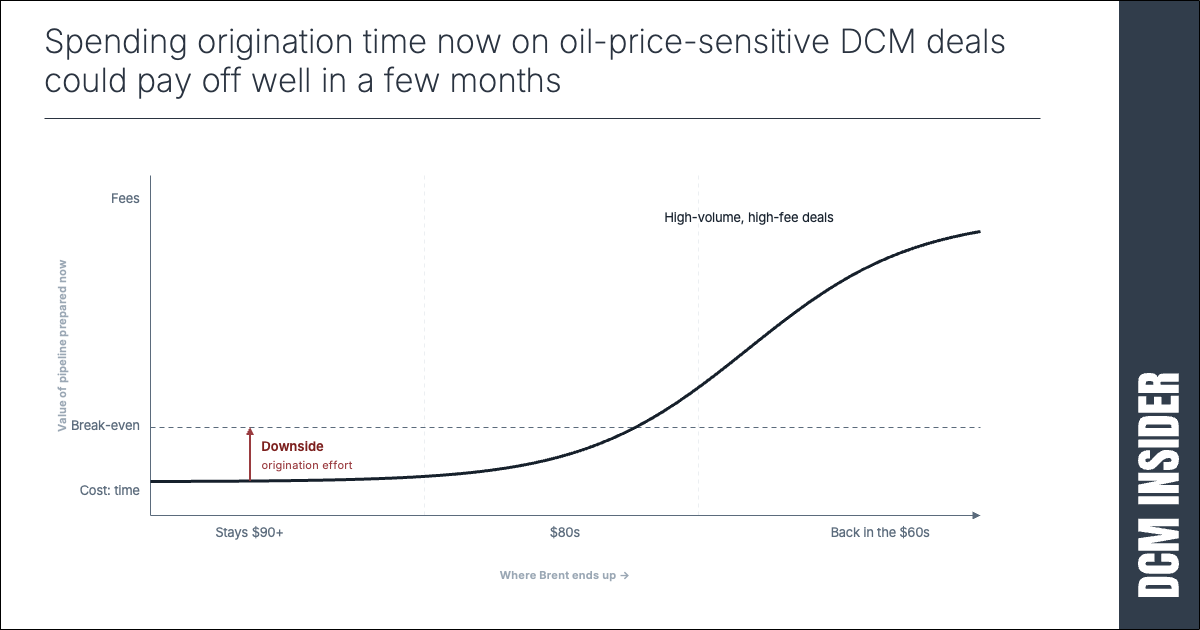
- Oil prices – Still a major risk for the credit markets – potentially affecting inflation, inflation expectations, politics in many regions of the world, and credit quality/pricing. There might be a materially higher risk of movement in the next few weeks ahead of the 3rd November elections. Brent crude is up to $106 now. Following the elections, there is a possible scenario in which incentives might turn towards deescalation – and we have a less volatile situation.
- Inflation data – US CPI data is released on Wednesday. If this is higher than expected, there is a chance that this starts moving rates higher again.
Key data points:
Oil Price (Brent Crude): $106 (up $6 on the week).
UST 10-year: 5.2% (down 0.1% on the week). Around highest levels since 2002.
UST 30-year: 5.6% (0.1% lower). Around highest levels since 2002.
IG Spread (ICE BofA US Corporate OAS): 82bps. Down 3bps on the week.
HY Spread (ICE BofA US HY OAS): 315bps. Up 5bps. Risen rapidly. Compare with 266bps on 21st September.
CCC/lower Spread (ICE BofA CCC and lower OAS): 12.52%. Up 0.50% on the week. This was less than 10% in July.