June non-farm payrolls were 57,000, which was lower than expectations. This slightly changes the consensus, which was that the economy was doing very well and inflation was high, which meant that it was easy for the Fed to raise rates to control inflation. If the economy is doing less well than expected, as this data point suggests, that would reduce the Fed’s ability to raise rates.
A slowing economy, with higher inflation, could make the Fed’s job difficult.
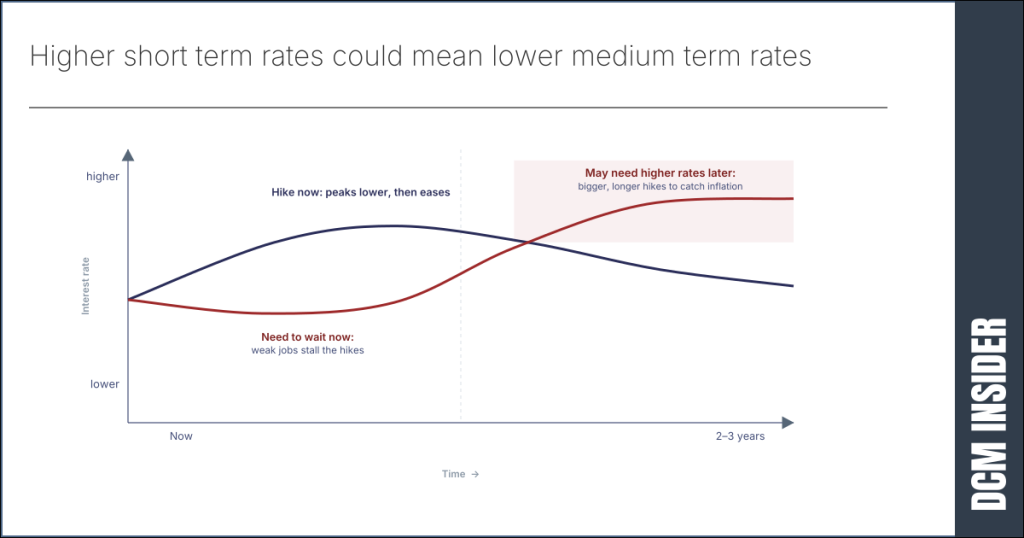
The view amongst rates traders had switched from the beginning of this year, from being one of falling rates to being one of increasing rates, after oil prices increased during the year. It seemed this would be relatively easy for the Fed to do because the economy and employment were performing well. If the economy is actually performing less well than expected, this could reduce the ability of the Fed to increase rates as much or as quickly as might be needed to control inflation.
Risk of higher medium-term rates
If the Fed is not able to raise rates quickly or as quickly as needed to control inflation because of its effect on a weak employment market, this could allow inflation to continue to increase materially. If that happens, then the Fed may need to increase rates more than otherwise and hold rates higher for a longer period of time than otherwise. This could result in higher medium and long-term rates.
The counterargument
There are a number of cases in which there is no stagflation risk. In one case, the economy and employment could be performing very well, and this weaker payrolls figure is an outlier data point. In another case, inflation could ease by itself with the Strait of Hormuz potentially returning to normal traffic levels and oil prices falling. It is also possible that there is not second-order inflation now built into the system through higher producer prices and inflation expectations. An important longer-term effect could be that artificial intelligence is significantly deflationary, which could materially reduce long-term rates.
Issuers and investors may want to protect against higher medium and long-term rates
Most issuers look to borrow for periods longer than two years. Issuers should evaluate the scenario and consider whether they believe this to be plausible, and, if so, consider protecting themselves by issuing early and for longer tenors or through interest rate derivatives. Similarly, investors who believe that this could be a risk might want to reconsider their duration profile.