The UK’s Chancellor has announced that the country will issue its first digital Gilt by early 2027. This will play a part in encouraging Gilt investors to build the infrastructure to buy and trade digital bonds. Digital bonds will create a more efficient market, with lower fees per deal in some areas, and potentially materially more bond issuance and trading.
Benchmark effect
This issue is a benchmark for digital ledger technology (DLT) issued bonds. Digital bonds are not new but this is the first from a G7 sovereign. It lays the foundation for the UK government to issue more and larger digital bond deals – in part with the aim of making the UK a leader in this technology. To this end, it also creates competition between financial centres – encouraging other countries to follow suit quickly and issue their own digital bonds.
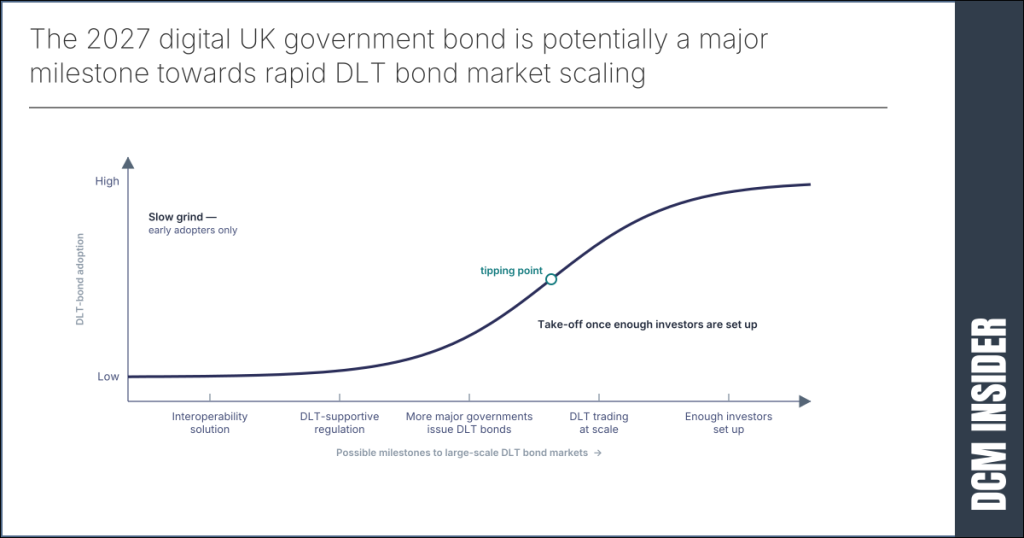
This issuance makes investors set up their own internal infrastructure for holding and trading digital bonds. As a tipping point is reached and enough investors have this in place, corporate borrowers will start to use DLT traded bonds – particularly if investors start to prefer this format and demand it, or if regulators start to require/incentivise it.
Trillions of dollars by 2030
Tokenised securities total less than $20 billion today. Citi has recently projected that this will reach over $5 trillion by 2030, and Boston Consulting Group puts its 2030 number at $16 trillion. These projects are across all asset classes (not just bonds).
The magnitude and speed is unknown – but there is now a reasonable chance that this happens at scale.
What this does – bond trading
Bond digitisation may make bond trading (including for currently illiquid high-yield and structured deals) more liquid – largely by reducing barriers to entry for market making (in traditional bank/broker and in electronic trading system formats). It does not directly help with the data, research and analysis needed.
This could all open up new opportunities – like new forms of algorithmic trading in bond markets with immediate settlement and very low transaction costs.
New bond market investors, bond markets for mid-market borrowers
Second order effects could be a bigger range of investors (as investors do not need the difficult trading lines currently needed for many types of less liquid bond), more market liquidity, lower issuance costs for borrowers, more competition among arrangers (particularly if secondary market making, which currently is a major advantage for larger arrangers, becomes less important), and more issuance.
This could in turn increase the relative attractiveness of bond markets to syndicated loan and private credit markets for the marginal issuer. It might also open bonds markets to smaller bonds issues – potentially opening bonds markets for mid-market borrowers over time. Regulations, ratings and other barriers for mid-market borrowers may adapt to capture value that lower issuance and settlement costs open.
Bond administration providers expand services
Demand for settlement and payment agent services is likely to fall. New administrative work will be needed – like on-chain custodians, wallet providers and validators. This could be in the context of a market which grows materially in size and trading volume.
Delay/failure scenarios
The move to DLT settled bonds seems to need material government effort to push through. There is a chance that support drops off – particularly if it becomes a worry that this will be bad for the profitability of the country’s financial industry.
Interoperability is another worry. The UK government has selected HSBC Orion as the DLT platform to issue this bond. The government has said that interoperability is a key focus – and they have set up a link with the London Stock Exchange Group (LSEG) which mirrors the holding data and allows trading through LSEG. If this proves to work well, it might form the basis for a more open system of links between blockchains – preventing fragmentation and bad liquidity, which would put investors off investing to set up the infrastructure to trade these bonds and make the initial inertia needed to get this market going much higher. There is a chance that this stalls bond digitisation.
If these issues bite, we could find the use of DLT technology for bonds largely abandoned – especially if new technological options (for example opened by AI developments) that achieve the benefits of using DLT without the problems arise.
Scenario plan but with uncertain timing
There seems to be a fair chance that DLT-traded bonds will grow rapidly. Market participants may want to project what this would mean for their business – risks and opportunities it creates. This understanding and these plans would then help participants watch the market and spot when the “tipping point” occurs for them to start to take action (for example a solution on interoperability, DLT bond supportive regulations, DLT infrastructure set up by enough other investors, etc.).