The bondholders are reported to have entered a cooperation agreement that binds investors to act together during restructuring negotiations.
Cooperation agreement
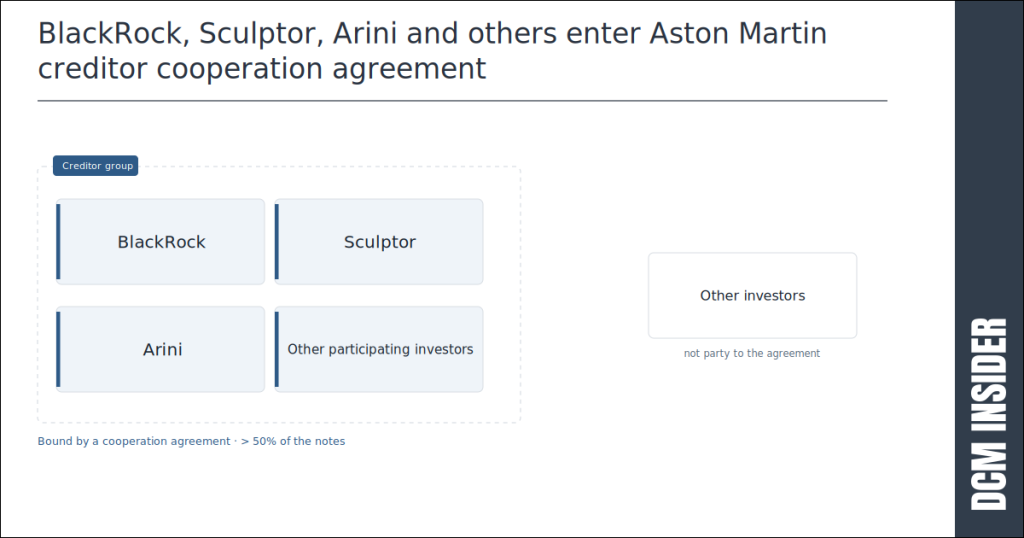
A group of creditors led by BlackRock, Sculptor and Arini is reported to have formed a creditor group for holders of Aston Martin’s bonds. They reportedly have over 50% of the notional value of the outstanding bonds, and are inviting more investors to join the group.
Aston Martin earnings trouble
The company has $960 million in USD bonds and £400 million in GBP bonds maturing 2029. Aston Martin may find itself in financial distress before then on the back of lower earnings than anticipated because of factors including competition, the US tariff quota mechanism, and lower China/Asia demand.
Fitch downgraded Aston Martin’s senior secured notes to CCC+ in May.
Loose covenants
The bonds have relatively loose covenants – creating the risk that Aston Martin could run an aggressive liability management exercise (LME) as is increasingly common for distressed company management teams trying to find a path forward. A £50 million financing facility was provided earlier this year by shareholders that Fitch treats as sitting above the existing bondholders and says the facility primes the bonds – it is secured against an operating asset.
Avoiding creditor-on-creditor violence
By working together, the creditors in the pact may be able to avoid “creditor-on-creditor” violence – where the company is able to advantage one group of creditors over another as a way to get enough bondholders to vote to approve changes or other actions that need bondholder consent.
Bonds trading around 70 cents
The bonds were issued in March 2024 with a 10% coupon for the USD bonds and a 10.375% coupon for the GBP bonds. Both bonds now trade around 70 cents.
Liability management exercises (LMEs) determine how much value goes to creditors and how much to shareholders
This type of cooperation exercise can materially move value from equity to bondholders in a distressed scenario.
Law firms becoming specialists
The creditors are working with Akin Gump Strauss Hauer & Feld on this deal. These LME deals are becoming dominated by a small number of law firms (on the issuer and investor sides) who are gaining expertise and reputation for successful execution. These deals can be high value for law firms.
Game theory – could encourage equity support
The cooperation agreement could change the payoff of the options available to shareholders, and could encourage them to invest more equity into the company if they see good turnaround potential. That could be a good scenario for bondholders.