This would be the largest vendor-financing platform of all time. It allows buyers to access large amounts of finance at subsidized rates.
AA-rated NVIDIA has announced a $500 billion platform to support the purchase of its AI chips.
The purchasers who would be financed could include AI labs (like Anthropic and OpenAI), large companies, and AI cloud providers (who operate data centers and sell capacity to other companies).
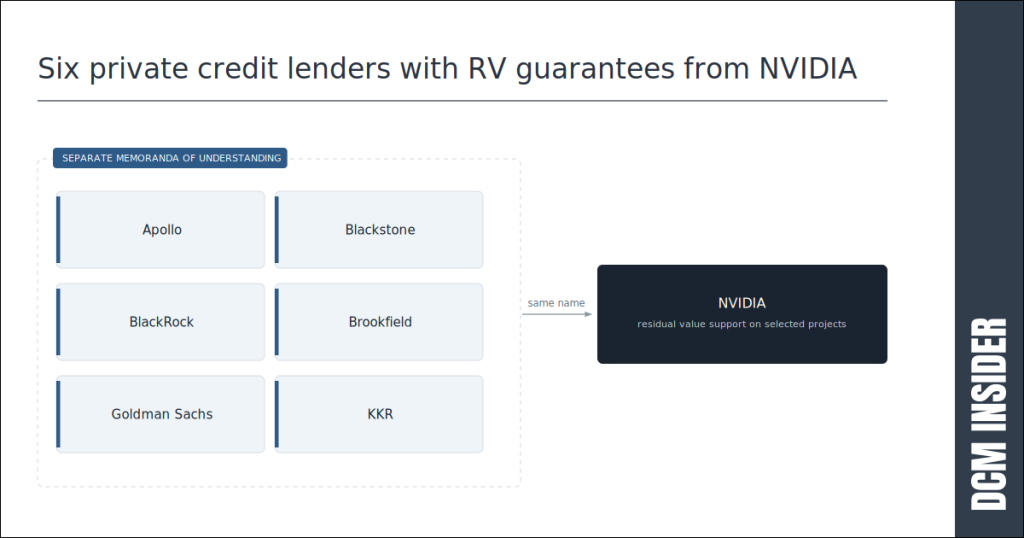
The platform is currently a set of independent memorandums of understanding with Apollo, Blackstone, BlackRock, Brookfield, Goldman Sachs and KKR.
Given the value here for NVIDIA, the private credit investors, and data center operators who buy NVIDIA chips – it is likely that this translates into real deals and a large amount of funding deployed.
Residual value guarantee
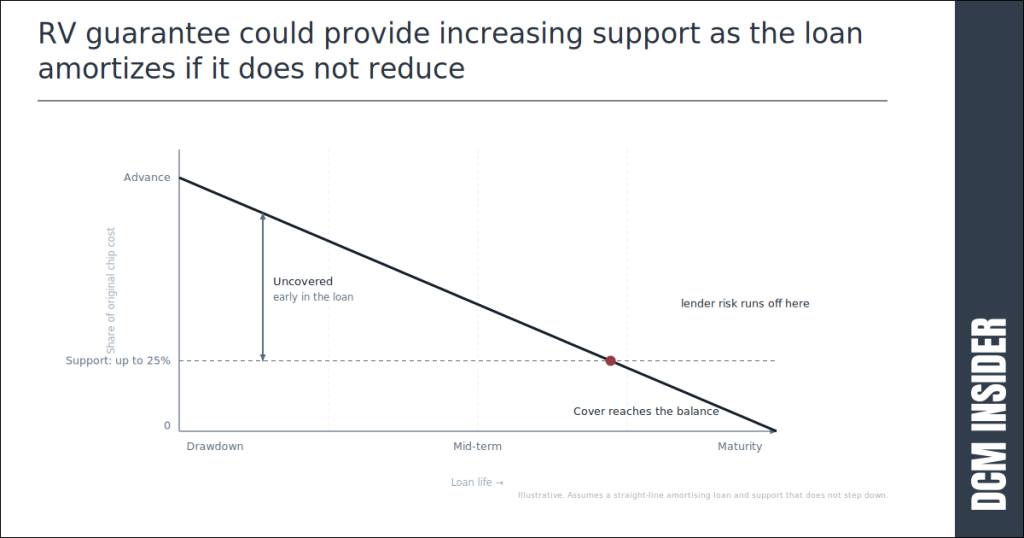
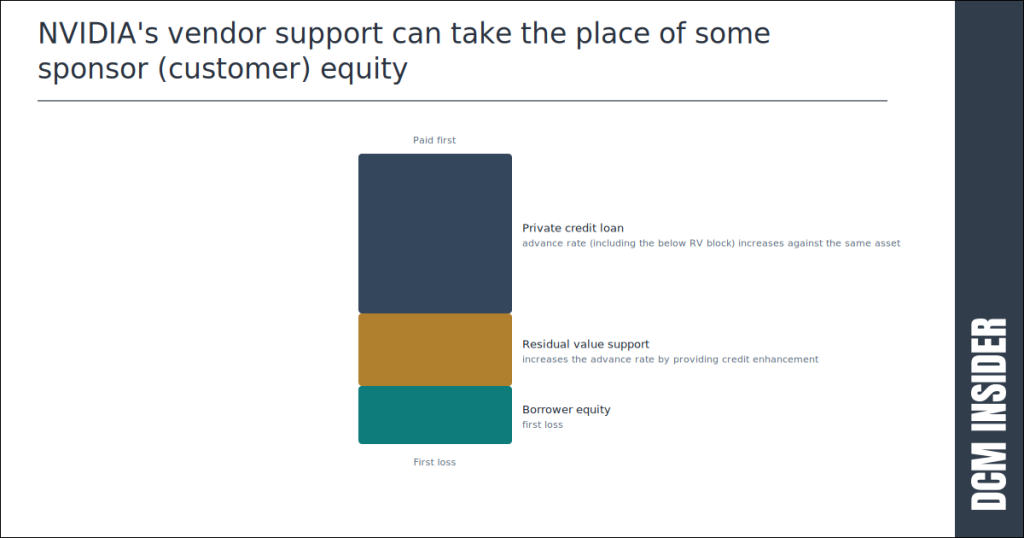
NVIDIA says that it may provide residual-value support of up to 25% – on a project-by-project basis.
This residual value guarantee (RV guarantee) can materially increase the amount that lenders can provide to a borrower that is buying NVIDIA AI chips – as the investor knows that in case of default, they can claim under the guarantee. If the RV guarantee does not reduce in value as the loan value reduces (as it is paid back over time), the private credit lender’s risk can fall rapidly.
Value for private credit lenders
Private credit lenders are sitting on large amounts of dry powder – and are in a race to gain scale on the broadly used assumption that the biggest private credit lenders will win as the market consolidates.
This type of deal can allow them to deploy large amounts of capital quickly.
The fact that this platform seems to only be open to the largest private credit lenders might support the “scale will win in private credit” argument.
Value for NVIDIA
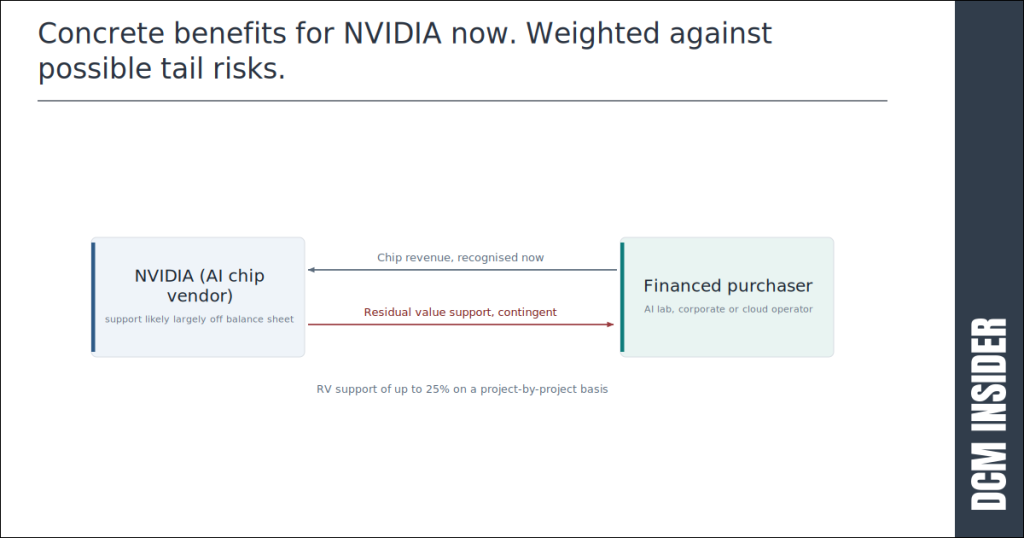
In the short term, NVIDIA supports its own revenue (as is usual with vendor financing).
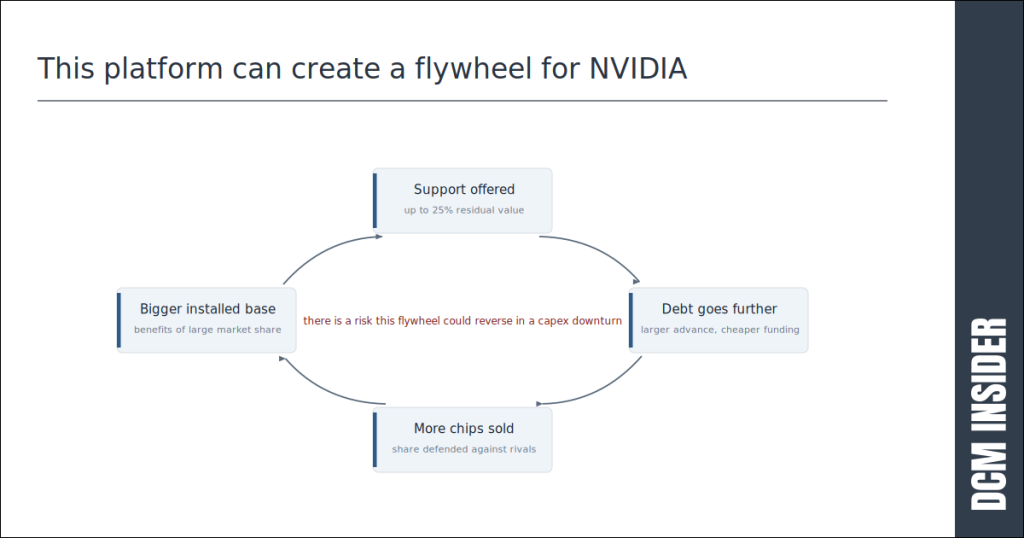
By making it cheaper to buy NVIDIA chips in large quantities for customers than alternatives (with financing availability/costs being a major buy consideration), NVIDIA can secure sales over competitors.
Another value driver is competition – there is a rapidly growing set of global competitors to NVIDIA’s AI chips – including Google, Amazon/AWS, Microsoft, Meta, Broadcom, Huawei, Alibaba and Baidu.
NVIDIA likely wants to avoid losing market share. NVIDIA’s proprietary CUDA programming system has historically been a big moat for NVIDIA – as the learning curve for developers who program with AI chips was steep for switching to another programming platform (that uses different chips). But this moat has reduced – both (ironically) because AI makes translating code between languages much easier (and AI writes much more of the code now itself – and it does not have the learning-curve constraint that humans have), and because other software frameworks have been developed that let developers code in a way that is agnostic of the chips used (those frameworks that effectively write the code for the chips being used themselves).
The nature of these RV guarantees means that they are likely to be largely off-balance sheet for NVIDIA.
Tail credit risk for NVIDIA
NVIDIA may be taking tail risk – that if there is an AI investment crash, NVIDIA’s revenue could fall significantly and at the same time it may need to pay out on RV guarantees under these deals. NVIDIA and the lenders have likely determined that the likelihood of this state of the world is low and/or the total loss under this scenario is manageable – relative to the benefit that comes from doing these deals now.
More platforms likely from other AI chip manufacturers
It is likely that we will see similar vendor financing support from other chip manufacturers. Broadcom provided a similar residual value guarantee on the $35 billion private credit financing for Anthropic led by Apollo and Blackstone in June.
Advertisement