Author: k

  • DCM Insider Weekly – 12th May 2026

    DCM Insider Weekly – 12th May 2026

    Record new issuance and close to all time low spreads. Experienced borrowers locking in funds.

    In short:

    Credit markets are positive – with record levels of new issuance and close to all time low spreads. It seems to be an excellent window for issuers to lock in their funding needs, and for investors who want to reduce/resculpt their risk profiles.

    Top talking points: 

    1. Experienced borrowers locking in funds: Large deals from Alphabet, Eli Lilly, Saudi Arabia’s Public Investment Fund, HSBC, Westpac, Morgan Stanley. The fact that large issuers are taking this window to lock in funds might be a valuable signal for other borrowers to consider.
    2. Good jobs data increases chances of rate increases: Non-farm payrolls data came in better than expected. As the Fed needs to contain inflation while protecting employment – good employment data reduce the “rock and hard place” problem for the Fed. If inflation starts going higher because of higher oil prices (that we have already had for over 2 months now), the Fed may be forced to raise rates.
    3. Hyperscalers are broadening their issuance across credit markets: Alphabet sold €9 billion in euro bonds and its first ever Canadian dollar bonds (C$ 8.5 billion). We expect a lot more international issuance by hyperscalers – as well as issuance in other credit markets (securitisation, private credit and leveraged loans) – as their capex needs are too large for any one market to absorb. This will likely have second order effects on these other markets – including increased competition for other issuers in these markets, and improved market liquidity
    4. Warsh to run down the Fed’s balance sheet – which may increase long-end rates and credit spreads: Kevin Warsh is expected to be confirmed as Fed chair this week. He wants to reduce the size of the Fed’s balance sheet – potentially selling long term bonds that the Fed has bought. This could increase the supply of long term bonds in the market – increasing long term interest rates and credit spreads.

    Primary markets:

    Public – positive and active. Large bond deals from Alphabet (€9 billion and C$8.5 billion), Eli Lilly ($9 billion), Saudi Arabia’s Public Investment Fund ($7 billion), HSBC ($4.5 billion), Westpac ($4 billion), Morgan Stanley ($3 billion).

    Private – markets open. Focus shifting from mid market direct lending to other strategies including asset-backed finance, real estate and investment grade. Apollo closed a $1.9 billion opportunistic private fund that targets market dislocations – from pension funds, financials, endowments, foundations and family offices.

    Asset-backed – primary markets wide open as private credit increases demand competition. Soloviev raised $1.8 billion against a New York office tower from Bank of America, Wells Fargo, Citi at 4.9% (5 year). SKY Leasing priced an $813 million aircraft lease-backed ABS. Triton priced a heavily oversubscribed $350 million shipping-container backed ABS with a total order book of $1.7 billion – pointing to strong investor demand. Fair Oaks priced a €380 million European CLO at tight spreads across the capital structure – pointing to strong investor demand.

    Quotes of the week:

    “There’s always a risk of rate hikes when inflation has gone above target, and it’s been persistently above target now, and the labor markets are strong. And there’s signs that the labor market weakness that we were worried about just three or four months ago is largely dissipating.”

    Ken Griffin, Citadel CEO

    “We believe periods of volatility and dispersion create compelling opportunities for capital providers who are prepared to act decisively.”

    Chris Lahoud, Apollo Partner – on the closing of their new $1.9 billion private credit fund that targets market dislocations last week.

    Key legal and regulatory:

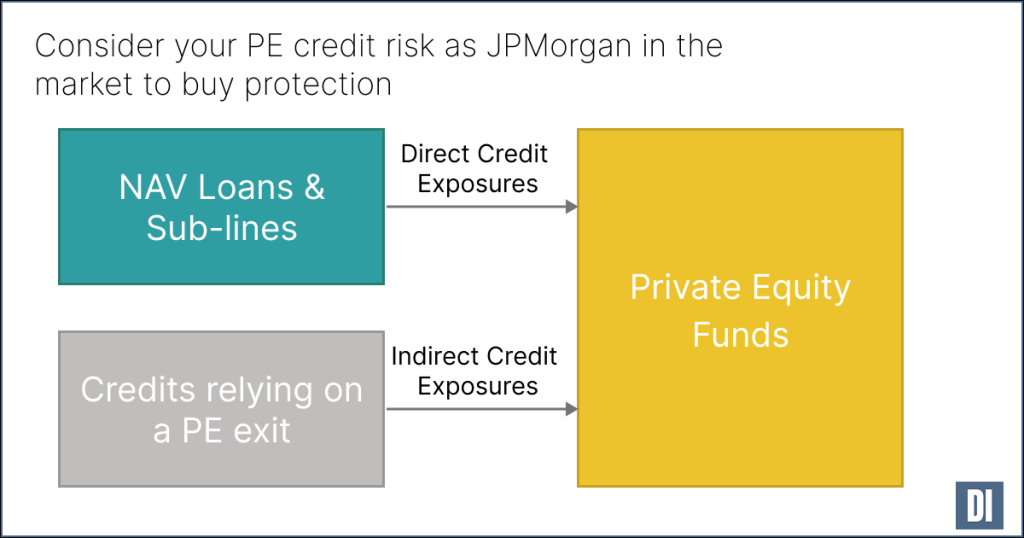
    FSB Report on Private Credit Risks: The Financial Stability Board (the international body established after the 2008 global financial crisis that monitors the global financial system) published a report that talks about risks from contagion risks (because of bank lending/other credit exposures to private credit, insurer exposure to private credit, and private equity interconnectedness), credit quality worries and valuation errors/opacity. A key point is that private credit in its current form is new – and untested during a prolonged economic downturn. This will feed into how regulators around the world look at private credit – including potentially more closely monitoring regulated bank risk to private credit. The end effects might be limited given the broader value the private credit creates and a current environment of global financial markets deregulation/international competition.

    What to watch this week:

    1. Iran war: The situation has been relatively stable over the last week. There seems to be an interest from all sides (for varying reasons) in continuing the ceasefire. But if we see a change – that could affect oil prices and then credit markets. 
    2. US Inflation: US CPI data for April is released on Tuesday. PPI is released on Wednesday. This could move markets a little – though given the current robustness of markets, it seems unlikely to affect markets too much unless there is a large overshoot/undershoot.

    Key data points:

    Oil Price (Brent Crude): $103. Down from $113 on the week. Has now been elevated for over 2 months (from around $70 in February).

    UST 10-year: 4.4%. There is a chance that this increases as Kevin Warsh becomes Fed chair and starts reducing the Fed’s balance sheet (potentially  selling bonds).

    Short reads:

    A 1-minute summary of the FSB report on vulnerabilities in private credit: https://www.fsb.org/2026/05/report-on-vulnerabilities-in-private-credit/

  • Investors should manage the risk of more “aggressive” liability management exercises on their portfolios

    Investors should manage the risk of more “aggressive” liability management exercises on their portfolios

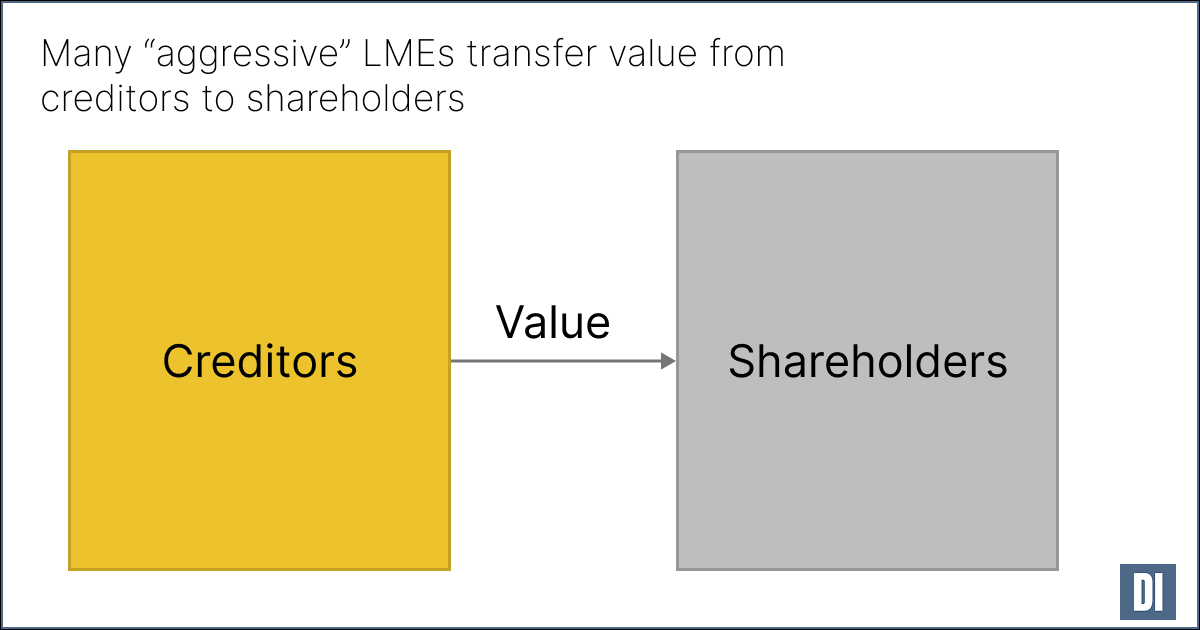
    Many “aggressive” LMEs transfer value from creditors to shareholders

    Who – This is an issue for high yield bond, private credit, and leveraged loan investors.

    What’s happening – Stressed issuers are increasingly using “aggressive” liability management transactions that take value from creditors and pass it to shareholders.

    History – This has come about because a lot of currently stressed deals were issued during “ultra-low-interest-rate boom times” – when it seemed very unlikely that some of these companies would default, and so investors were willing to accept weaker covenant packages (which translate to lower recoveries in cases of default) in return for higher yields.

    How – There are a range of mechanisms used by companies – including moving assets out of reach of creditors, buying debt from some creditors at a premium to others in exchange for cooperation that benefits equity holders, and raising new borrowings in ways that essentially dilutes existing creditors. Terms for these transactions include “Dropdowns”, “Uptiers”, “Double Dips”, “Triple Dips”, “Pari Plus” – essentially the exact mechanics of each does not matter for our context here – just that they navigate through legal documents to often transfer value from creditors to shareholders.

    Some win-win situations – In some cases liability management exercises can be beneficial all-round – for example avoiding legal costs of a court restructuring or avoiding the reputational/brand harm from a high-profile court restructuring. This “saved value” can then be shared in some way between creditors and equity holders.

    Recent deals – there have been a lot of liability management exercises in the last few years. It is most prevalent in the US, and growing in Europe. Some high-profile deals include ones by: J. Crew, Revlon, Chewy, Serta Simmons, Incora/Wesco Aircraft, Trinseo, iHeartMedia, Altice France, Pluralsight, Envision Healthcare, Carvana, DISH Network, Hunkemöller, Lumen, Sabre, Spirit Airlines.

    Implications for investors – Investors should be aware of companies that they have exposure to that could end up stressed, assess the type of liability management exercise that could be open to them, assess the economic cost to them of such an LME, and assess how likely it is that the company would do that. Investors can then consider whether they want to continue to hold that credit, and if so whether they need to take action to protect themselves. 

    Investor protections – Investors may in some cases be able to preempt this type of exercise by maintaining a close relationship and strong dialogue with company management and its sponsors. Creditors have also started forming clubs – in some cases with legally binding cooperation agreements between lenders to avoid creditor-on-creditor violence (where the company can work with one group of creditors at the disadvantage of another). This is all legally complex and might be best suited to specialist investors in many cases. Cooperation agreements have also recently been legally challenged in some cases as a form of “illegal cartel”.

    Distressed investor opportunities – The complexity, legal costs, and potential reputational costs of working through these LME exercises as an investor can result in some original investors wanting to sell this type of exposure. Specialist distressed investors may in some cases be paid well for being able to work through deals in detail to identify value, and to navigate through any LME process. There are also active strategies being run by some investors like the “Hunter Gatherer” strategy – where an investor “hunts” (buys) enough existing debt in the secondary market to help approve a debt change proposal by the borrower, and then “gathers” (exchanges) those holdings into a higher value instrument with the borrower.

  • DCM Insider Weekly – 4th May 2026

    DCM Insider Weekly – 4th May 2026

    DCM Insider Weekly Newsletter - 4th May 2026

    In short:

    Markets continue to be positive, but meaningful risks exist for issuers and investors. Risks include higher oil price effects of the Iran war, inflation, higher interest rates, contagion from private credit bad loans, new policies before midterm elections, and large new issue supply from hyperscalers.

    Top talking points: 

    1. Protection from external events: External events mean credit investors and issuers may want to de-risk. There are risks (both downside and upside) from external events including the effects of the Iran war on oil prices. Investors and issuers may want to look for ways to protect themselves from some of these events. Positive news around the Strait of Hormuz may create good issuance windows.
    2. Borrowers locking in funds: The week saw issuers continue to lock in funds. This included a $25 billion bond deal from Meta and a $6.5 billion bond deal from Intel.
    3. Interest rates up: There has been a shift from expecting interest rate cuts to potential interest rate increases. Higher inflation numbers and low unemployment create conditions in which the Fed may begin to raise rates.
    4. Massive hyperscaler credit supply is changing the credit markets: New issue supply from the hyperscalers (the largest cloud computing providers including Amazon, Microsoft, Google, Meta, Oracle) is a massive new source of supply for the credit markets. We are starting to see signs of credit markets finding it difficult to absorb all this extra supply – for example Meta’s $25 billion bond this week priced at a higher spread than its October 2025 deal. Expect increasing hyperscaler credit issuance across bonds, securitization, private credit and leveraged finance.

    Primary markets:

    Public – positive and active. Large bond deals from Meta ($25 billion), Intel ($6.5 billion), Walmart ($4.25 billion), JPMorgan ($3 billion), BBVA ($2.25 billion).

    Private – Markets remain open for most categories. Primary Wave (partly owned by Brookfield) closed a $2.2 billion music royalties fund (upsizing from its initial target of $1.5 billion). This points to strong demand for asset-backed private credit. The investor base was broad – insurance companies, pension funds, endowments, large family offices.

    Leveraged finance – Active, open markets. Data centre operator Coreweave launched a $3.1 billion broadly syndicated deal. The deal is marketed as a GPU financing – with the loans backed by customer contracts for AI data center capacity. M&A related leveraged finance markets open – with BASF Coatings launching a $2 billion loan sale to finance its acquisition by Carlyle and Qatar Investment Authority.

    Quotes of the week:

    “The way it’s going now, there will be some kind of bond crisis, and then we’ll have to deal with it … We haven’t had a credit recession in so long, so when we have one, it would be worse than people think.”

    Jamie Dimon, JPMorgan CEO

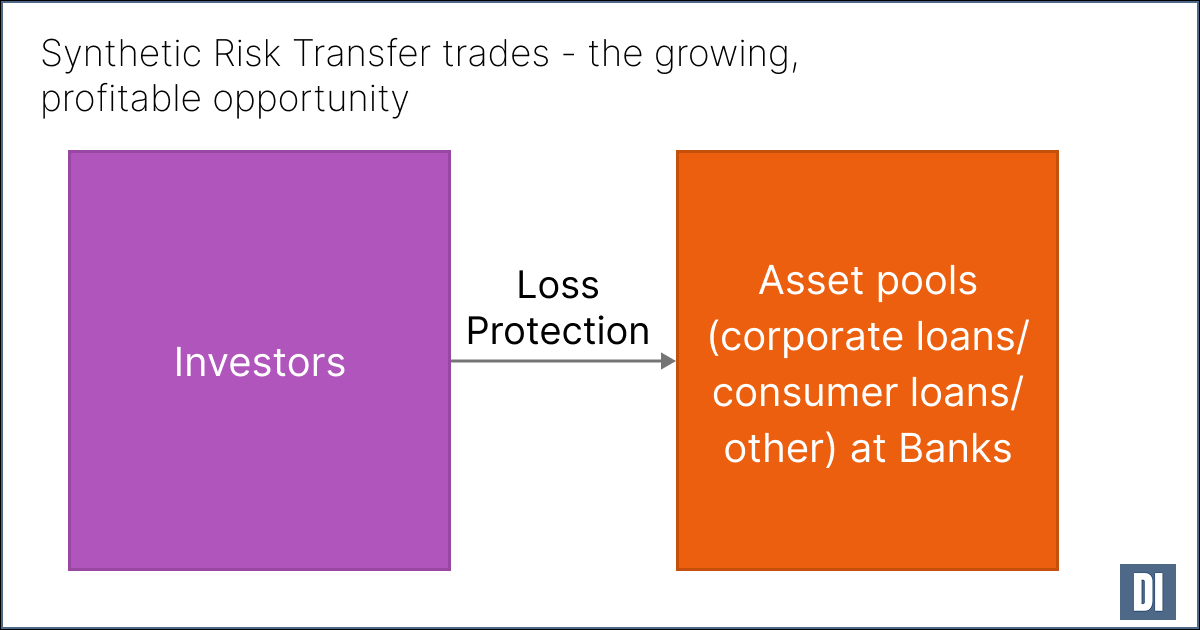
    “..nearly half of euro area banks reported using either traditional or synthetic securitisation. Synthetic significant risk transfer (SRT) is the most commonly cited form of securitisation deemed important by euro area banks, followed by non-SRT traditional securitisation and SRT traditional securitisation.”

    ECB Report

    What to watch this week:

    1. Strait of Hormuz developments: We are likely to see some changes in the Iran war this week which will affect credit markets. How high oil prices get, and how long they stay high is potentially the most important driver for fixed income markets – for interest rates, default rates, and credit spreads.
    2. Nonfarm payrolls on Friday: These will affect dialogue around interest rates by the Fed and by traders. A strong economic print (low unemployment) could increase interest rates. 

    Key data points:

    US PCE Inflation: 0.7% for the month of March (up from 0.4% for February). This is a high reading, and a large increase.

    Oil Price (Brent Crude): $114. Up from $104 on the week.

    $700 billion+: New (increased) capex projections from hyperscalers announced in their recent earnings reports. Much of this will likely be funded with bonds, securitisation, private credit and leveraged loans.

    UST 10-year: 4.5%. Up around 0.1% on the week

    Short reads:

    A short note from S&P on how the duration of the Strait of Hormuz closure will affect credit quality across industries and geographies: https://www.spglobal.com/ratings/en/regulatory/article/creditweek-what-does-the-fragile-middle-east-ceasefire-mean-for-credit-s101683316

  • Position for Defence DCM

    Position for Defence DCM

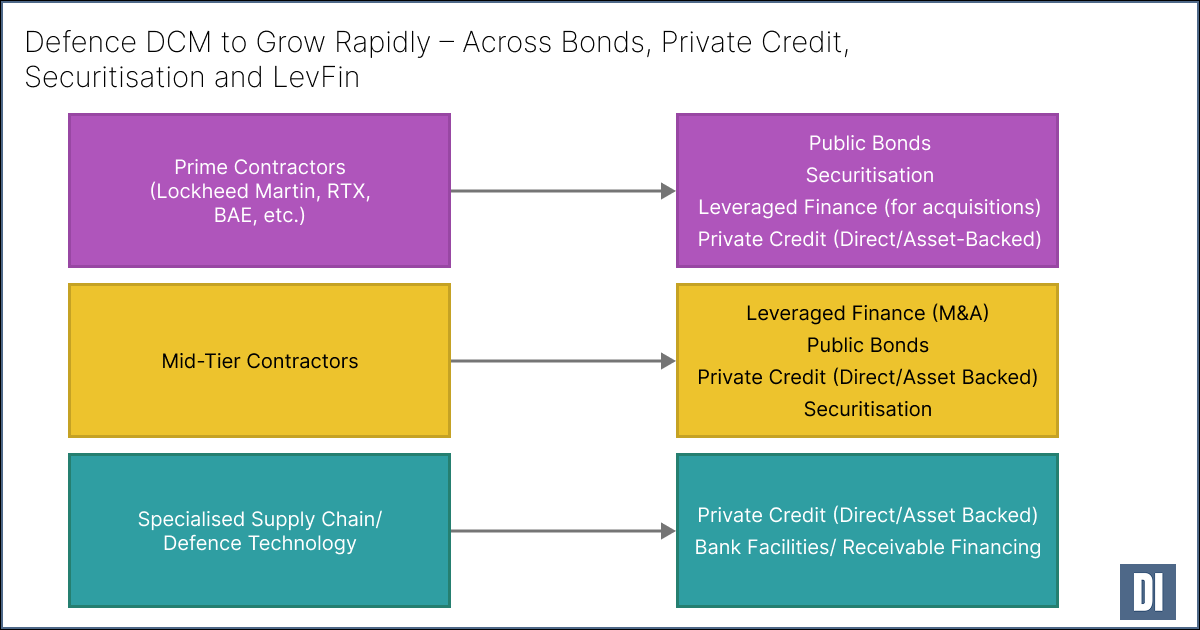
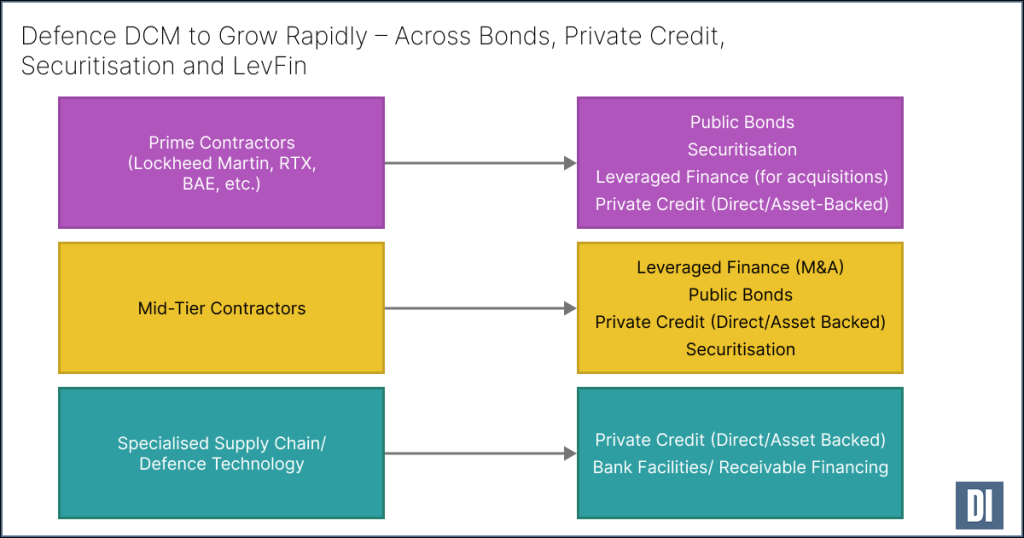
    Defence DCM – across bonds, private credit, securitisation and leveraged finance – is likely to grow very rapidly.

    Why: geopolitical changes mean trillions more of defence spending and changes in end investor perceptions

    Geopolitical changes have changed how the public and end investors perceive defence investments. They have moved from being seeing as a destructive industry to avoid, to one that is necessary for peace and security.

    There are two important changes for debt capital markets participants that follow from this: 1) governments are spending MUCH more on defence – estimated to increase from $2.6 trillion/year now to $7 trillion/year by 2035; 2) end investor perception has changed – with many more investors now willing to invest in defence related assets. As an indicator of the second – defence sector bonds are now being included in some ESG frameworks.

    So what: CapEx, working capital and M&A

    The magnitude of this potential additional spending on the debt capital markets is difficult to overstate – with defence-related credit potentially becoming a major part of the bond, private credit, leveraged finance and securitisation markets.

    Credit markets will: i) fund CapEx, ii) fund working capital, iii) fund M&A.

    By market: levfin, working capital, private credit, securitisation

    Leveraged finance

    Potential for a LOT of M&A. The market is highly fragmented below the largest players (the “Tier 1 Prime Contractors” like Lockheed Martin, RTX, Northrop Grumman, etc.).

    Working capital

    There could be hundreds of billions of working capital needed to finance production – with production taking years for some products.

    Private credit

    Many deals will be well served by private credit funds – with fast, flexible, confidential deals. This may allow managers to offer LPs a private credit premium over public credit. Managers have started launching specialist defence-linked private credit funds. These recent funds include Sienna Hephaistos Private Investments, Grays Peak Private Credit II, Leonid Private Credit Fund I.

    Securitisation

    Potential for hundreds of billions of dollars of public and private asset backed financing for capex and of receivables. Receivables will often by government-linked.

    For participants: investors, private credit, issuers, investment banks, law firms, governments

    Bond investors

    Consider allocation to defence sector credits. Possible that current [10 to 30] bps defence bond premium will fall. Possible that end investor demand will grow rapidly. Potential for diversification – including if there is a recession.

    Private credit

    Consider investment in defence sector credits. Explore demand for specialist defence sector funds among LPs.

    Issuers

    Explore new funding options. This could provide an edge that allows primes and subcontractors to be able to beat competitors on costs and win new mandates. Being an early mover in the capital markets could also provide a significant competitive advantage by becoming known by investors, building a track record, and being able to raise more credit at lower costs than competitors. This may also affect how M&A plays out – which companies end up being the acquirers.

    Investment banks

    Consider positioning for origination, structuring and distribution of defence credit. Look at new defence funding programs including the EUR 800 billion EU ReArm Europe Plan, $1.5 trillion “Security and Resilience Initiative”, the EUR 150 billion Security Action for Europe (SAFE) program.

    Law firms

    Explore growing your defence sector debt capital markets capabilities – including various new Defence Bond frameworks, new ESG/ESSG (with “Security” added) frameworks, special risks for investors and arrangers in defence sector deals, due diligence for these risks.

    Governments

    Consider developing Defence Bond labels. Consider legal and economic protections for investors in the defence sector. Consider programmes to support investments in your defence industry.