Public bond markets remained very active over the past week, especially for August. Strong credit demand and spreads close to 25-year lows helped issuers access the market across investment grade and high yield.
Investment grade
Martin Marietta Materials led disclosed investment-grade activity with a $5.5 billion transaction to finance its acquisition of Lhoist North America. AMD followed with $4.75 billion, while Verizon raised $3.75 billion.
| Issuer | Amount | Purpose or context supplied |
|---|---|---|
| Martin Marietta Materials | $5.5bn | Funding the acquisition of Lhoist North America |
| AMD | $4.75bn | US chip company |
| Verizon | $3.75bn | Public investment-grade issuance |
| ANZ | A$4.25bn ($3bn) | Australian-dollar issuance |
| Charles Schwab | $2.6bn | Public investment-grade issuance |
| Lloyds | $2.5bn | UK bank issuance |
| Swedbank | €1bn | Public investment-grade issuance |
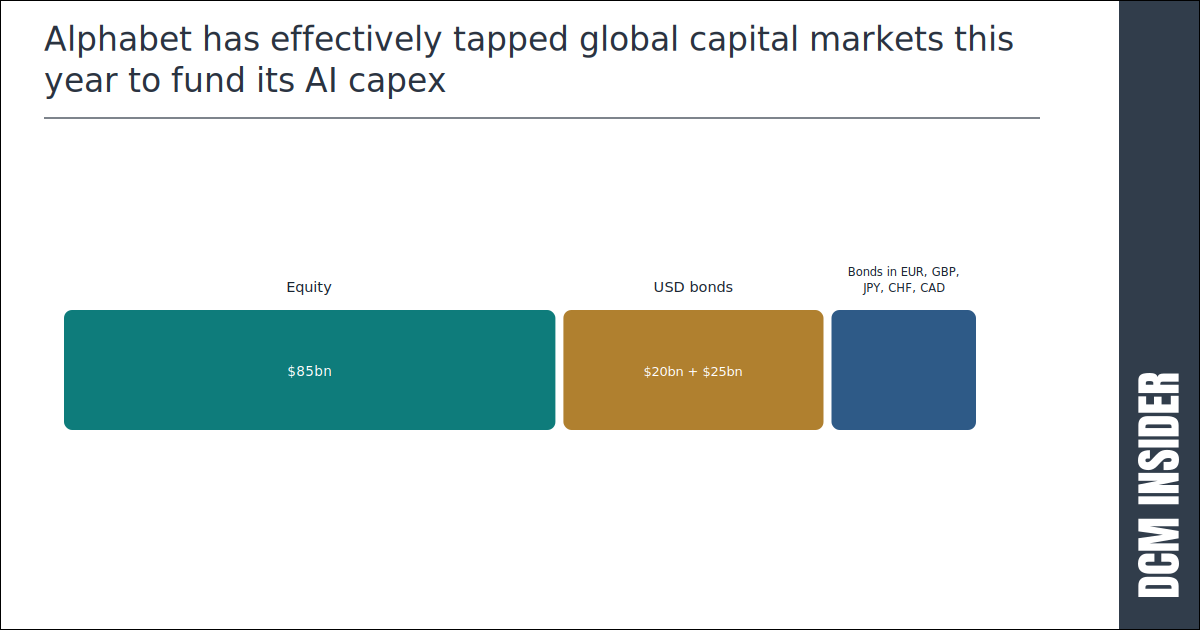
Alphabet is also reportedly preparing to enter the market with its first Australian-dollar bond. That potential transaction comes as AI-related borrowers continue to look for markets and structures capable of increasing their financing capacity.
High yield
Two transactions accounted for $4.75 billion of disclosed public high-yield activity. A $2.25 billion bond deal will finance the Zenith Arc data-centre project, backed by a lease with Jane Street. Ford Motor Credit, the captive auto-loan provider, raised $2.5 billion.
| Issuer or project | Amount | Purpose or structure |
|---|---|---|
| Zenith Arc data-centre project | $2.25bn | Project financing backed by a lease with Jane Street |
| Ford Motor Credit | $2.5bn | Captive auto-loan provider |
Emerging-market issuance
Indian banks continued to issue offshore, with $700 million from Bank of Baroda and $500 million from State Bank of India. Vietnam’s Techcombank is separately in the market for a $1 billion offshore loan.
Stressed and distressed: airBaltic bonds fell after the company announced a restructuring plan that includes a debt-for-equity swap. The bonds are now trading at around 23 cents.
The market backdrop
Investment-grade spreads are at 80 basis points and US high-yield spreads are at 267 basis points, both around 25-year lows. Higher underlying rates are attracting capital to fixed income, helping to sustain strong demand for new credit.