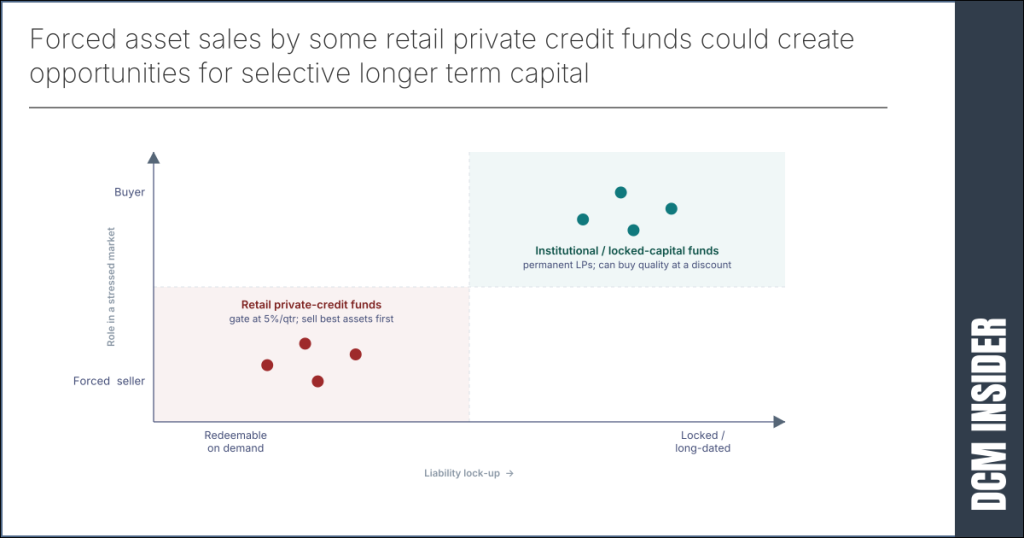
There is a risk that some funds will sell their best, most liquid assets first, leaving behind a deteriorating credit quality portfolio. As investors will be aware of this dynamic, this could fuel redemptions, creating a negative cycle. This creates an incentive for managers who are able to, because they have good assets or for other reasons, to find ways to reassure investors.
18.5% a year is meaningful
Capped redemptions quickly add up. 5% a quarter is 18.5% a year. To raise sufficient liquidity to meet these redemptions can result in some managers selling their best, most liquid assets first. Because selling a median asset could result in a large markdown – if either valuations on the book are too high or there is too little liquidity in the secondary market for that kind of asset.
Reducing NAV quality
If the best liquid loans are being sold first, that can result in a falling average quality of what’s left in some cases. Investors are aware this could be the case. Given that this is a credit product, there is limited upside but meaningful downside, as with all credit, and so investors may be quick to exit.
Managers may look to find solutions to reassure investors and avoid a negative cycle
Some possibilities may include: following Apollo’s plan to mark all their credit assets daily and transparently; selling representative sets of assets from a portfolio in a transparent manner that allows investors to see that the assets in the portfolio are valued at levels at which they can be sold quickly; or structures which have the support of the manager, for example, bringing in new investors to show confidence in the portfolio and providing that large investor with some form of protection or enhancement that is provided by the manager.
More regulatory scrutiny and bank leverage reduction could accelerate this trend
Regulators are increasingly focusing on the potential risks and issues in the private credit sector, including how a problem could reduce credit availability across the economy and create a systemic issue. As part of this scrutiny, regulators around the world have been talking about private credit valuations, their transparency, and their accuracy. The scrutiny and potential requirements that come from it could reduce marks and require additional asset sales. Similarly, if banks reduce the leverage available to private credit funds, this may also reduce returns and could result in forced fire sales to raise the liquidity that was previously provided by the back leverage.
Risk of contagion to non-retail private credit
The redemption issues at retail private credit funds that are getting high redemption requests and are gating at 5% may be a form of asset-liability mismatch. These may be specific for these kinds of funds, as many other funds will have long-term funds that are from institutional investors, which are permanent or long-dated. The risk to these funds is more second-order, where the news and regulatory responses from this news could result in bank leverage provision responses, which could result in issues for some funds. On the other hand, these developments might reduce competition for these funds, supporting yields, and could create opportunities for funds that are able to buy assets or buy high-quality assets at discounted levels, which could provide a material uplift to their performance.
Advertisement