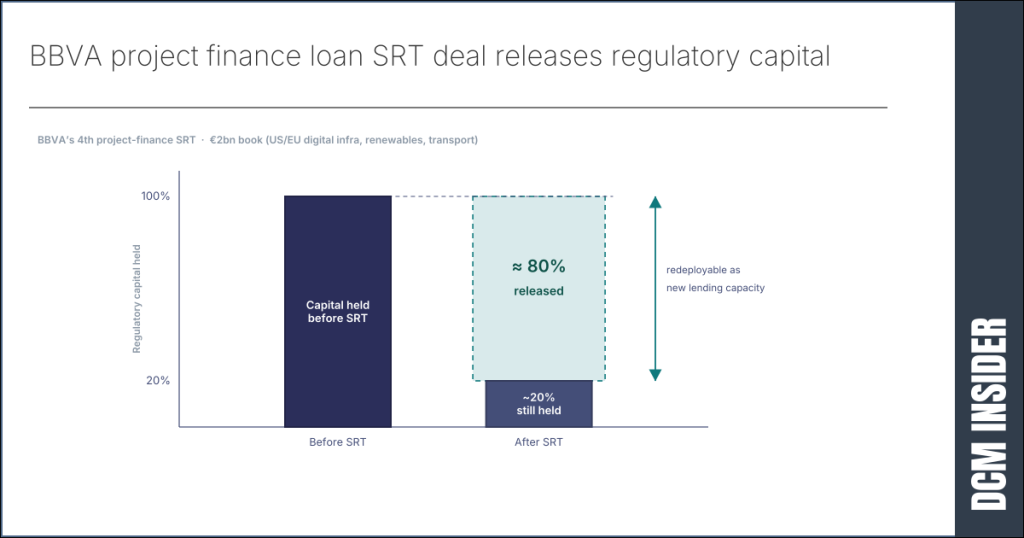
This is BBVA’s fourth project finance SRT. SRT transactions are growing rapidly in Europe and becoming a highly effective tool for banks to free up regulatory capital, free up new lending capacity, and improve their financial performance.
SRT transactions – like insurance
SRT (Significant Risk Transfer) transactions are similar to insurance – where the protection buyer pays a premium to the protection seller, and in return if there are losses on some specified assets, the protection seller will pay the protection buyer some/all of the money they lost on those assets.
Frees up regulatory capital
Through SRT transactions, banks are able to reduce the regulatory capital they need to hold. If the cost of buying protection on the assets is less than the cost of holding capital against the assets – this results in an immediate profit.
That is why SRT trades are often very valuable on assets that need the bank to hold high levels of regulatory capital – like project finance loans in this case.
BBVA reported that this deal has released close to 80% of the regulatory capital that it was required to hold against the €2 billion loan portfolio.
Can be good for the bank and good for the economy
This €2 billion loan portfolio was for projects in digital infrastructure, renewable energy, transport and other public services – mostly in the US and Europe.
By freeing up the regulatory capital that the bank needs to hold against this portfolio, it potentially allows the bank to make new loans for this type of project.
In addition to regulatory capital reduction, it can also reduce the risk the bank holds for particular sectors, industries, countries or borrowers – potentially helping avoid concentration limits.
AI infrastructure lending
This deal includes digital infrastructure projects – a large part of which is now AI infrastructure globally. By reducing regulatory capital and risk against this industry and individual borrowers, this deal may allow BBVA to grow market share in this fast-growing, high-value sector.
Structuring flexibility to meet investor demand
BBVA structured this transaction to be funded at the first-loss tranche level but unfunded at the mezzanine tranche level – to match what its investors wanted. As these transactions typically involve a very small number of parties, this type of structural flexibility can improve pricing for the issuer. Typical buyers for this type of deal are private credit funds. Insurers are also increasingly active at the mezz level.
SRT deals growing
This asset class has been growing rapidly. It is likely to continue to grow rapidly around the world. It provides an asset that can be modelled to private credit funds looking for high single digit/double digit returns, and frees up equity for banks at a cost lower than their cost of equity. Regulatory changes may affect the speed of issuance – with a lighter bank capital approach starting to be taken by regulators around the world – starting with the US – potentially reducing the need/benefit for SRT deals in some cases, but other regulatory changes (for example expected securitisation rule easing in the EU) potentially improving the economics for these deals.
Advertisement