Author: admin

  • Apollo’s Zito Warns of 20 Cent Recoveries on Software Private Credit Loans

    Apollo’s Zito Warns of 20 Cent Recoveries on Software Private Credit Loans

    Apollo Global Management’s co-president, John Zito, warned at a UBS event that recoveries on mid-market software loans for some companies taken private between 2018 and 2022 could be “somewhere between 20 and 40 cents”.
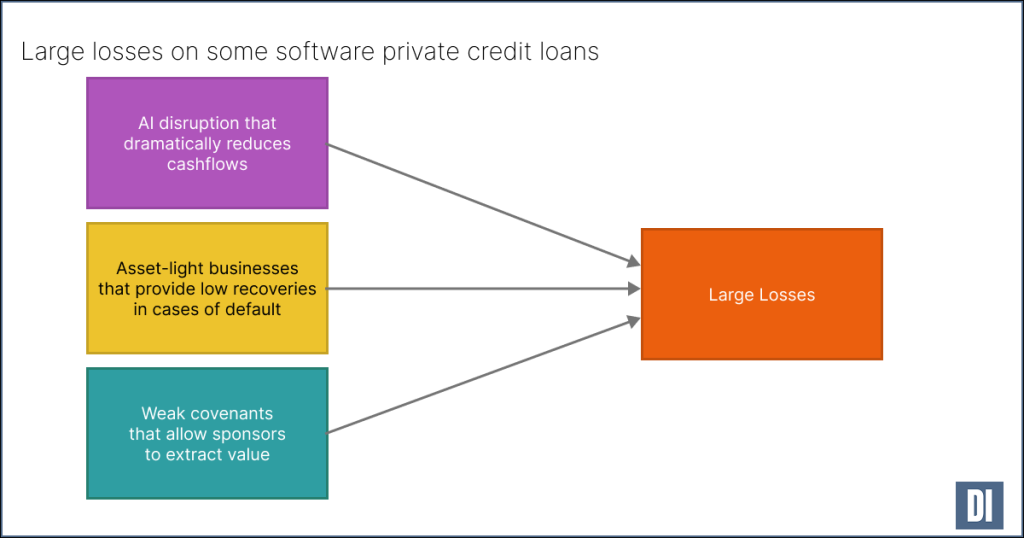
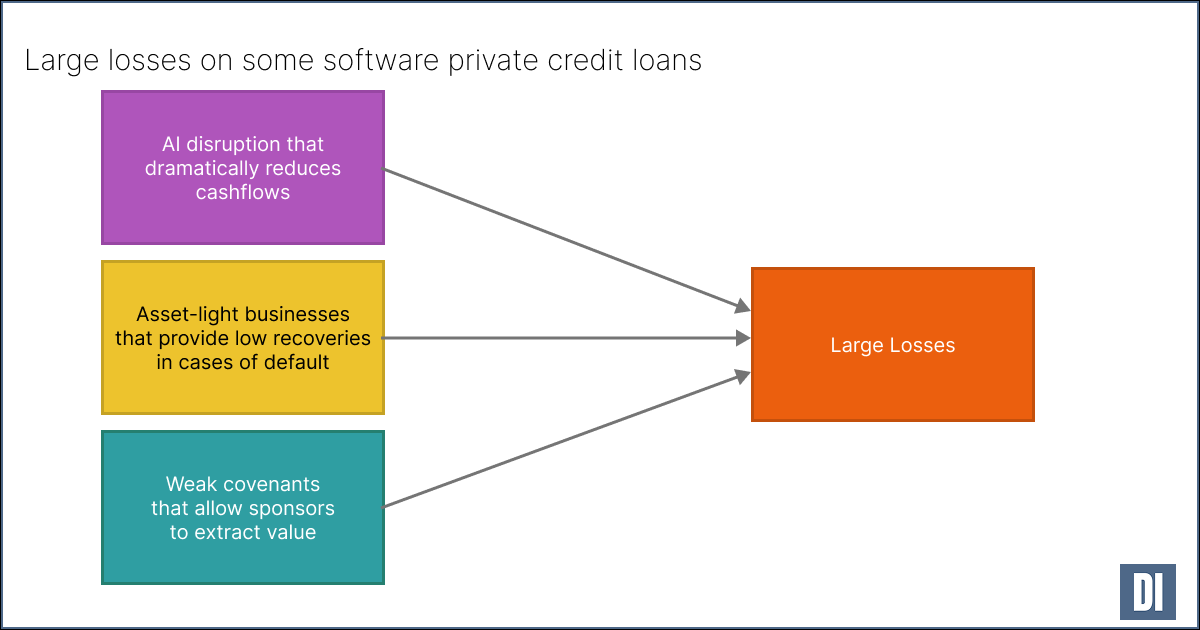
    Large losses on some software private credit loans

    The 2018 to 2022 period saw high valuations for software companies, and close to zero interest rates. AI fundamentally risks the business models of some of these software companies, and interest rates have risen a lot since then.

    This may in part be an attempt to position Apollo as a safe manager in a difficult period for the private credit industry – as Apollo has said they have a small exposure to software companies.

    But his insights might also be accurate. This fits with the credit markets’ usual “bubble creating” mistake of over-relying on stable historical data to predict future cashflows (over fundamental, future-focused market analysis and modelling).

    For some software companies that are disrupted by AI, stable historical cashflows might quickly fall – potentially making covering interest payments and refinancing difficult – which could result in a large number of defaults. As software companies are usually asset-light, recoveries might be particularly low relative to other sectors.

    Why this might overstate the problem in software private credit

    There is likely to be a range of outcomes for loans to software companies.

    Future cashflows: Software companies are not built equal – some software companies will do well in an AI world. Some will fare terribly. This will depend on things like their client base (retail or enterprise), how much proprietary data (including user data) they have and use, and how much of the service they are providing is truly software and how much of it is non-software (possibly disguised as software).

    Debt profiles: There will be a range of debt profiles – loan maturity profiles and loan terms. These will both affect how likely each company is to default, and what the recovery is for each investor. Many of the 2018 to 2022 software company LBOs were financed with unitranche structures – with agreements between lenders behind the scenes, which tranches repayments and recoveries among lenders.

    We have seen this type of deal already see some markdowns. For example, private credit lenders including Blackstone have been marking down their private credit loan exposure to marketing technology company Medallia, which was acquired by private equity firm Thoma Bravo in 2021. Some lenders have already marked this loan down to 77 cents.

    The big hidden risk – systemic risk: Private credit firms have been taking leverage from banks (“back-leverage”) on their private credit portfolios. An unknown risk is whether there is the risk of a systemic unwind here – where positions are marked down, triggers are breached in back-leverage, funds are forced to sell private credit positions, secondary-market private credit prices fall with increased supply/forced sellers, and that then further reduces valuations.

    Potential opportunities

    This environment could throw up opportunities for banks and investors.

    Sorting credit quality: There are likely to be many private credit loans that end up with large losses, but there are also likely to be many private credit loans which turn out to be very high credit quality and continue to be valued around par. Being able to work through the private credit universe might allow investors to find loans (or funds) which are strong credit quality and at some point end up dramatically underpriced. There might also be opportunities to short assets which investors assess could fall significantly.

    Leveraged finance: Some companies (and their sponsors) might start to find they suffer from pressure as financing maturities come up, or as they come up towards breaching covenants. There might be a considerable amount of M&A at that point – which will need debt funding, in an environment in which debt funding supply is limited. This might create opportunities to build portfolios of strong, well-structured, high-margin loans for leveraged finance providers who can effectively assess quality. It could also allow new or small leveraged finance providers to build a franchise that could then create value well beyond this credit cycle.
  • MFS – Suspected Private Credit Fraud – The Big Picture Implications

    MFS – Suspected Private Credit Fraud – The Big Picture Implications

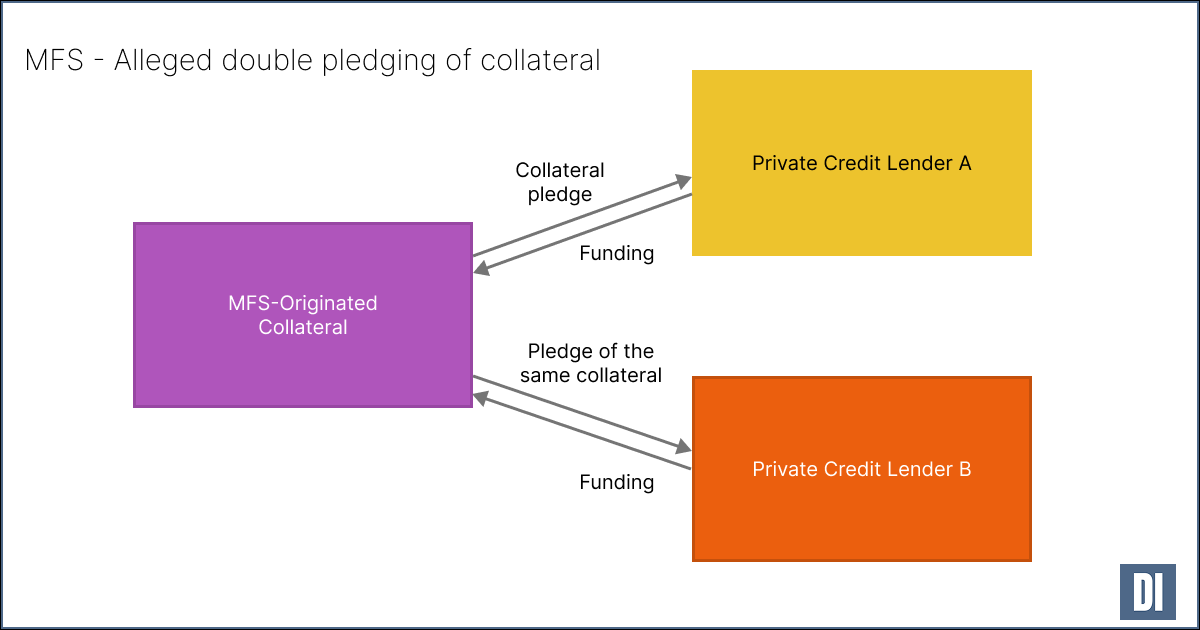
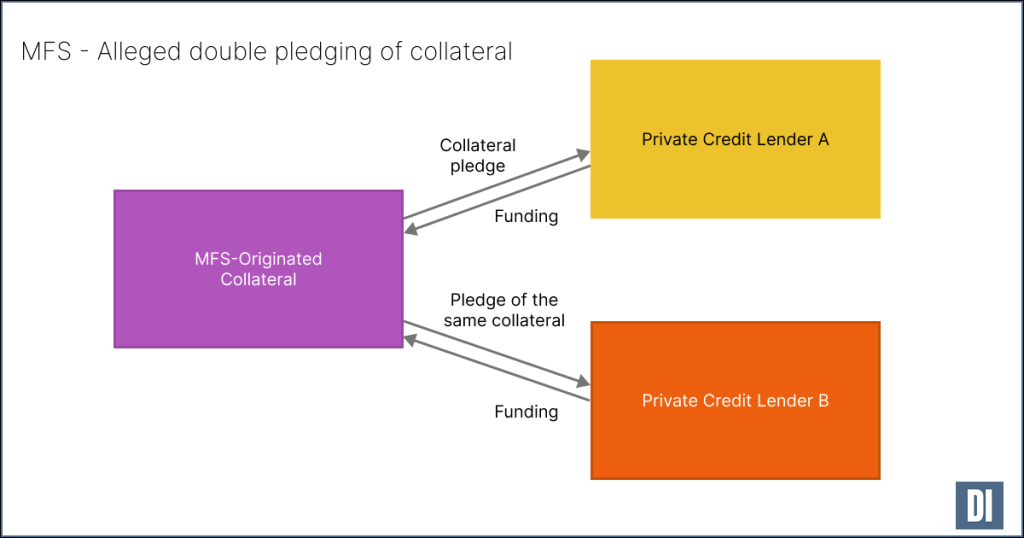
    Market Financial Solutions (MFS) is a specialist UK mortgage lender, that borrowed in the private credit markets from many leading private credit investors. Allegations include fraud – providing false information to lenders and pledging the same collateral to multiple lenders. This individual case is not systemically important (as the borrower is relatively small with a total loan book of £2.4bn at the end of 2024) – but what is systemically important is how it changes our view on whether there is hidden systemic risk from fraud and bad underwriting across the private credit market.

    MFS - Alleged double pledging of collateral

    MFS was put into administration in late February. This follows the collapse of other private credit borrowers on counts of alleged fraud including US-based auto parts supplier First Brands Group and US-based subprime auto lender Tricolor Auto Group. Double-pledging of collateral is also an issue in the First Brands and Tricolor cases.

    This set of events makes it more likely that there are hidden issues in parts of the private credit markets – around poor underwriting and servicing (including not spotting fraud).

    Investors included Barclays, Apollo’s Atlas SP Partners, Jefferies, and Santander. The lending seems to largely be in the form of warehouse facilities.

    This is likely to dampen parts of the private credit market – while investors assess potential losses, and private credit lenders strengthen their underwriting and servicing processes.

    What to watch for next

    Fraud at other mid-market originators: Watch for further private credit defaults from fraud. Private credit lenders are increasingly conducting deeper investigations into their investments in this type of company – which is likely to uncover fraud in some other cases. So we should expect to see some new cases come to surface in the coming months. The number of new cases that arise will help provide some feel as to how big an issue this is for the private credit markets.

    Mid-market private credit drying up and being the CAUSE of financial distress for mid-market originators: Private credit lenders are increasingly under pressure over this type of investment. This is likely to mean that they will pull back from some existing and some new investments to this type of lender. As many lenders will not have a similar source of borrowing (with warehouse facilities being relatively unique – being able to provide high levels of leverage at low rates), expect to see some lenders shrink or collapse simply because they can no longer access the funds they need.

    Changes in deal structures and underwriting requirements: Borrowers had a lot of negotiating power over the last few years – with large amounts of private credit capital that needed to be deployed and relatively few good investments available. This allowed originators to set many of the terms for the deals. This has changed with these defaults. Expect increased covenants, more transparency, closer monitoring, more auditing, and higher requirements on counterparties (who the trustees and administrators for the deal are, who the auditors are, etc.)

    Worst case – wider contagion – from lower credit affecting asset prices: If mid-market originators find it more difficult to get credit, we might find this translate into the markets they service – for example for the types of bridging loans for residential property that MFS provided. This could cause asset prices in those markets to fall. This could in turn reduce the credit quality of private credit investments in this space – creating a negative asset-price/credit availability spiral.

    Opportunities

    These situations are fast-moving and complex. Being able to differentiate between creditworthy and risky investments in the mid-market originator space could provide investors with trade opportunities.

    Investors who are able to better underwrite and service private credit to these mid-market originators might find an opportunity to find high risk-return investments. This could particularly be the case for investors who can get very hands on – deeply tapping into and monitoring the real-time data of lenders and closely auditing their assets.

    There may similarly be excellent opportunities to buy secondary positions for institutional investors who are better able to assess the risk of these deals. There might be some particularly attractive opportunities for subordinated tranches.

    Legal and regulatory effects

    Now that there are multiple cases of alleged fraud related to private credit investments, and given the effect that credit drying up can have on the economy, expect to see increased scrutiny from regulators. Regulators are likely to conduct reviews. The outcome might be slightly increased ongoing requirements on private credit investors (funds and banks) to take measures that help avoid losses from fraud by their borrowers.

  • Blue Owl’s Retail Private Credit Fund Problem – The Key Issues

    Blue Owl’s Retail Private Credit Fund Problem – The Key Issues

    Blue Owl Capital Inc is one of the world’s largest private credit fund managers.

    They have been in the news because they have stopped investors in their retail-focused private credit fund from being able to redeem 5% of their investment each quarter. This has led to worries about private credit assets being overvalued across the market.

    The key issues

    1) Can private credit valuations be relied upon? There is no good market price for many private credit investments, and investors often need to rely on the judgement and unbiased views of the people making the valuations.

    2) Worries of hidden “bad loans” across the private credit industry. There are questions about whether there are a lot of “bad loans” hidden across the private credit industry.

    3) Risk of a private credit crisis and a broader credit crisis. Because of how big the global private credit markets have become ($3 trillion+), there is a chance that a private credit crash could have large knock-on effects in the financial system, and that it could reduce credit availability in the real economy – resulting in lower GDP, employment and asset prices.

    “The story” – what has happened with Blue Owl’s OBDC II

    Blue Owl Capital Inc is one of the world’s largest private credit fund managers. They are listed on the NYSE.

    The short version of the story – Blue Owl has a retail fund called OBDC II – which allowed investors to redeem 5% of their investments each quarter. Blue Owl made changes last week which stopped investors from being able to do this – and this has caused broader worries about the private credit markets.

    The longer version –

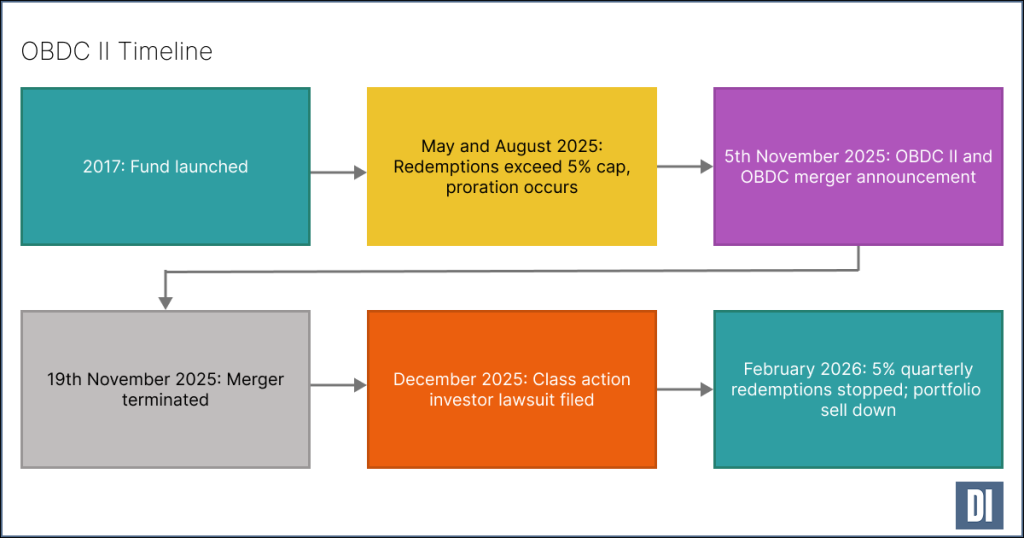
    OBDC II timeline

    Blue Owl has various private credit funds – including OBDC II which is targeted at retail investors. OBDC II is not listed and directly lends to US middle-market companies. It held investments in 190 companies with a stated NAV of $1.7bn (as of September 2025).

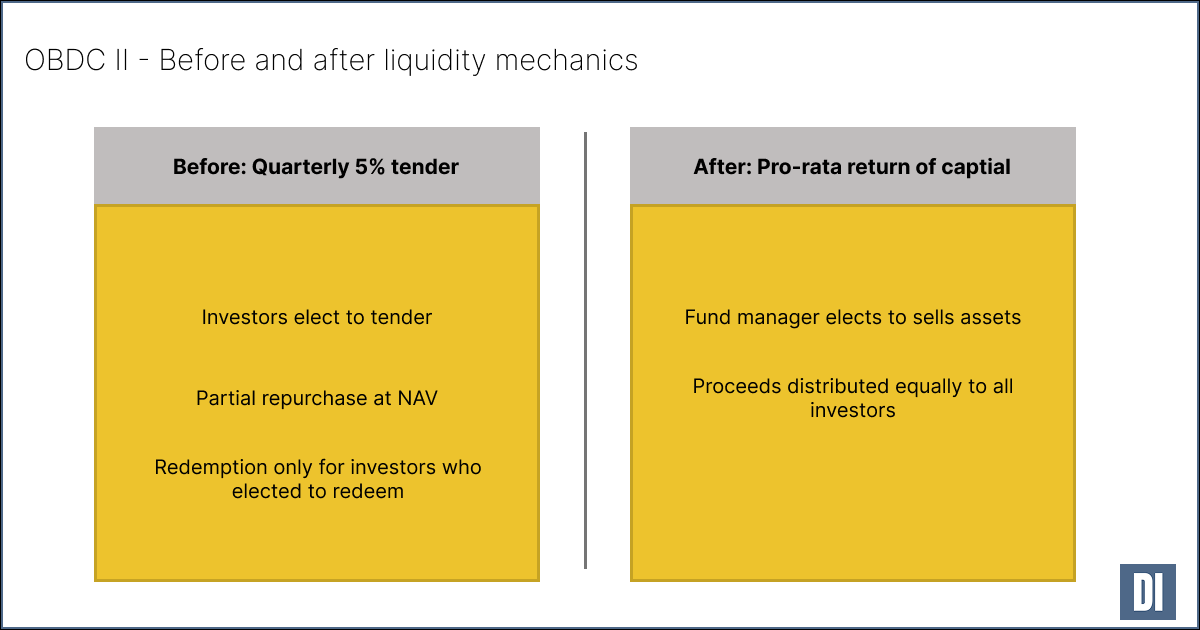
    Investors in OBDC II were able to redeem up to 5% of their holdings every quarter. The problem that Blue Owl faced is that the full 5% was starting to be redeemed each quarter – and it seems that Blue Owl was not able to do this without causing losses for the rest of the fund.

    This might be because of liquidity problems (it could not sell 5% of the loans at their marked value each quarter – but could sell them at their marked value with more time), it might be because of overstated valuations (the valuations on the loans should actually be lower than they were marked – because these loans are opaque it is easy to make mistakes on their valuations), or because of something else.

    Blue Owl tried to solve this by trying to merge OBDC II with a listed fund late last year (as then there would have been no more redemptions – investors would just sell their shares on the market when they wanted to sell) – but this would have resulted in a (paper) loss for OBDC II investors as the listed fund was trading at a 20% discount to its NAV – so OBDC II investors pushed against the merger and so that plan was called off.

    An investor lawsuit was filed in January 2026 claiming that Blue Owl misled investors about redemption pressures in its business development companies and about the likelihood of curbing redemptions.

    Then last Wednesday (18th February 2026) Blue Owl released a statement that meant that investors would no longer be able to redeem 5% of their investment each quarter. Instead, Blue Owl would start selling down some of the portfolio and return proceeds from those sales to all investors in OBDC II.

    OBDC II before and after liquidity mechanics

    OBDC II sold almost a third of its portfolio as the first such sell down. It sold $600m of its portfolio at close to par (99.7%). It will use the proceeds to repay a credit facility from Goldman Sachs and return funds to shareholders (around $538m – worth around 30% of the fund’s NAV).

    Some hedge funds including Saba Capital and Cox Capital last w eek announced that they will offer to buy shares in OBDC II from investors at 20% to 35% below NAV.

    The biggest question – is this an indicator of bad loans across private credit

    The biggest question is whether this event is an indicator that a large proportion of loans across the private credit industry are overvalued. The market is opaque (there are no traded prices as there are with liquid bonds) and information around a lot of private credit loans across the market is secret.

    There are worries that this change by Blue Owl is because they could not sell a big enough representative slice of the OBDC II portfolio each quarter to cover redemptions at the prices that the loans are currently marked. There is also a worry that Blue Owl was forced to make this change because OBDC II’s creditors (for example Goldman Sachs whose credit facility was repaid) required it.

    Even with the block sale at close to par (99.7%), the worry is that this does not reflect the actual value of the entire loan book of OBDC II. There are worries that it could be a friendly deal – at prices higher than they should be, and/or that the loans sold were effectively “cherry picked” – where the best/easiest to sell loans were sold, and a large proportion of the remaining portfolio contains loans that are marked above where they can be sold (a “toxic tail”).

    What we might see happen with OBDC II

    We might see OBDC II continue to run – with more block sales over time. The timing of these sales seems uncertain – they could happen quickly or it seems they could take very many years. It might turn out that the loans can be sold around (or above) current NAV – or it might turn out that some of OBDC II’s holdings end up being marked down over time.

    Manager backstop – Another interesting thing that could happen here is that Blue Owl could step in and support OBDC II. Blue Owl is a large, listed asset manager ($300bn+ AUM and $17bn market cap). OBDC II is small in comparison – at a little over $1bn AUM after the announced block sale is completed. This OBDC II issue is, however, causing a lot of noise for Blue Owl, affecting its share price (down 25% in the last month), and could affect its AUM if other investors avoid the noise around this and pull assets under management from Blue Owl. Blue Owl might be able to find relatively inexpensive ways to support OBDC II. We saw Blackstone support its retail focused real estate fund BREIT when it had redemption issues in 2022/2023 by providing a $1bn backstop and a guaranteed annualized net return of 11.25% to secure a $4bn investment from the University of California into the fund. This might be what funds like Saba and Cox which are offering to buy shares in OBDC II at a discount are betting on.

    Effects on the broader private credit market

    Risk of private credit market contagion – there is a chance that this event changes perceptions towards private credit, and then that relatively quickly creates a negative cycle of investors selling private credit, prices falling (in an illiquid market), and then more sales. This is by no means a given (or even a high probability case) – but given the size of the impact if it did happen, should be considered by market participants.

    This is an isolated event and the private credit market continues to develop – there is a chance that this is quickly seen as an isolated event (related to a suboptimal structure for giving private credit access to retail investors), and the private credit markets continue to develop. This event could even play a part in developing the secondary markets for private credit.

  • Interesting Electronic Arts Liability Management – Bond Prices Fall

    Interesting Electronic Arts Liability Management – Bond Prices Fall

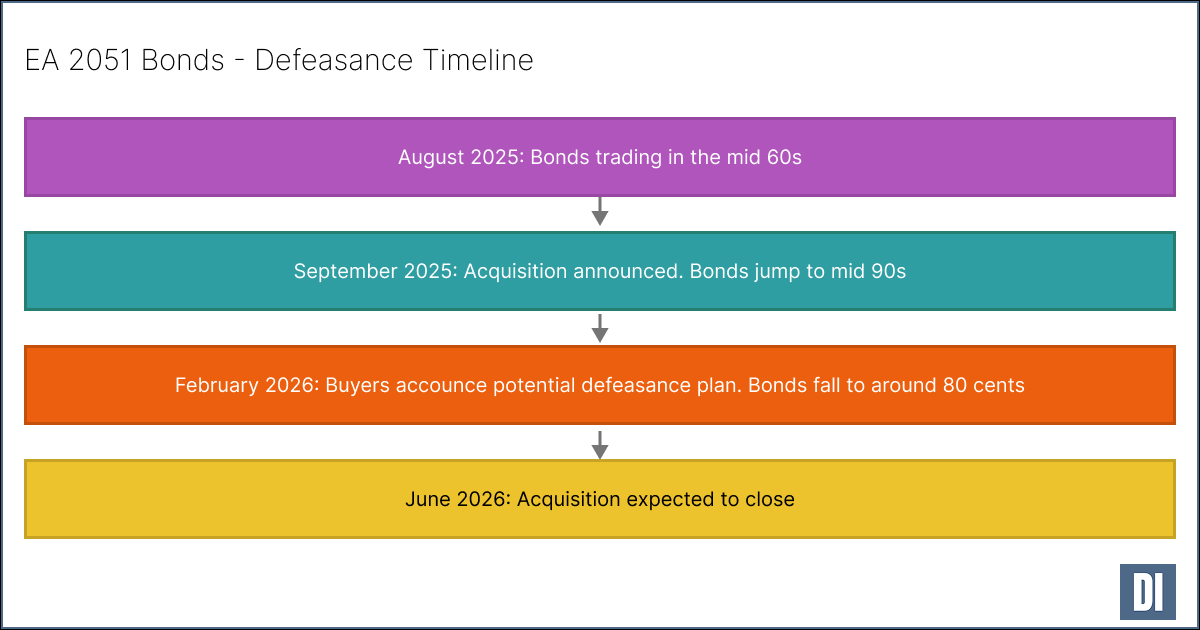
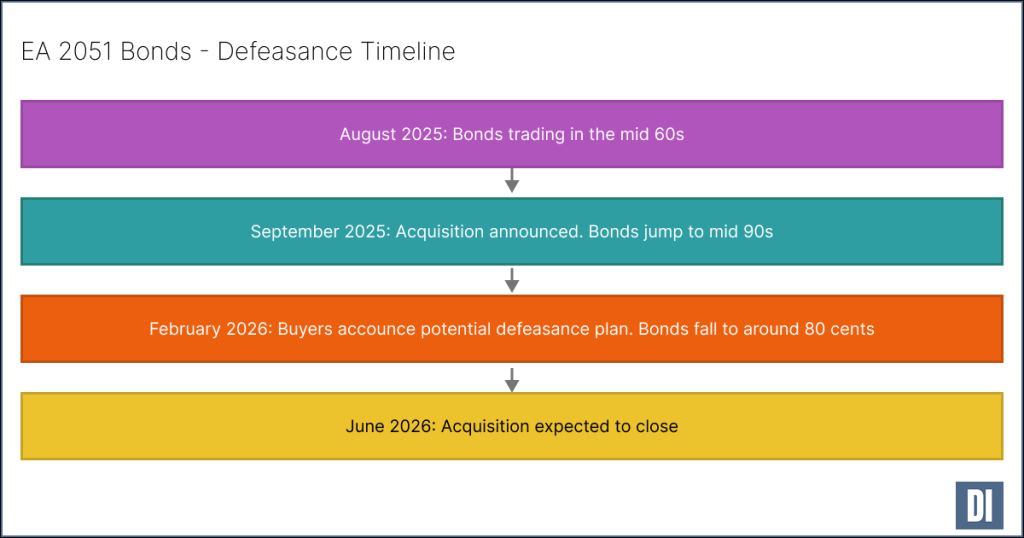
    Electronic Arts (EA) acquisition by the consortium of Silver Lake (private equity), PIF (the Saudi sovereign wealth fund) and Affinity Partners (private equity) was announced last year and is expected to close by the end of June this year.

    When the deal was announced, EA’s 2051 maturity bond prices went up from trading in the mid-60s to trading in the mid-90s – as investors thought that the “change of control repurchase event” provision in the bonds would result in the bonds being bought back soon at slightly above par (at 101 cents).

    The bonds were trading in the low 60s largely because they were issued in 2021 – and 30-year treasury yields have increased by over 1.5% since then (so need to discount the bond by a 1.5% higher rate over the next 25 years).

    So an immediate redemption at par (actually 101 cents as in this bond’s documents) would have been a big win for bondholders. Instead, EA used a defeasance option available to them under the bond – where they place treasuries as collateral against the bonds.

    Primer on defeasance

    Defeasance is an option that may be included in a bond’s indenture document. It allows an issuer to legally satisfy its obligations with respect to a bond in some way. The issuer is legally discharged from the debt – meaning it can be removed from their balance sheet even though the bonds are still outstanding. This is usually by depositing enough treasuries with the bond trustee to be able to pay back the full principal and interest due under the bonds to their maturity. The exact mechanism differs by bond and is laid out in the bond’s indenture document.

    This resulted in EA’s 2051 bond’s prices falling from around 95 cents to below 80 cents. Because investors still need to discount the cashflows by the higher current interest rate than when the bonds were first issued. On the plus side, they have no credit risk against EA (as the bonds are now collateralized by treasuries) – so that gives us a higher price than the low 60s level the bonds were trading at before.

    Expected outcomes for EA’s 2051 bondholders

    ScenarioPossible expected valueLogic
    Change of Control Put trigged101The bonds would have been bought back within a few months at 101 cents
    DefeasanceMid 70sThe bondholders still hold the bonds. They still suffer from a higher long term interest rate environment now than when the bonds were issued in 2021. But they no longer have EA’s credit risk (they are backed by US treasury bonds).
    Pre-acquisition announcementMid 60sInterest rate discount + higher EA credit risk

    This is a good case study for private equity funds and for bond investors. For private equity funds, it can in some cases allow them to pay more for a leveraged buyout (which is important in the currently competitive market for private equity deals). For investors it is a good reminder to work through the bond’s indenture documents in detail and play out what could happen. There was potentially an opportunity for investors to make a very quick profit here by spotting this opportunity and shorting the bonds when they traded in the 90s.

    The bond’s indenture document if you want to see the provisions: Indenture – SEC Filing. The Change of Control Repurchase Event is explained on page 13, and the Defeasance mechanism is explained on page 21.

  • Creditors Ask Court to Throw Out Optimum Antitrust Case that Could Change the Future of the Private and Public Credit Markets

    Creditors Ask Court to Throw Out Optimum Antitrust Case that Could Change the Future of the Private and Public Credit Markets

    Optimum Communications (formerly Altice) is the fourth largest telecommunications company in the US. It provides cable TV and broadband services to around 4.5 million customers. The company has $25bn+ of debt outstanding across loans, bonds and securitization transactions.

    The company filed a lawsuit in November accusing creditors of forming a cartel by entering into a cooperation agreement which the company says has effectively locked it out of the leveraged finance market and has prevented it from running liability management transactions.

    The creditors in the lawsuit are Apollo, Ares, BlackRock, GoldenTree, JP Morgan, Loomis Sayles, Oaktree and PGIM.

    The cooperation, among other things, prevents creditors from negotiating individually with Optimum, and requires a two-thirds supermajority for group decisions.

    The debt investors have asked the judge to dismiss the lawsuit – on the grounds that this is not an antitrust situation – including that they promote competition, reduce transaction costs, and prevent creditor-on-creditor opportunism.

    This potential for this type of “creditor-on-creditor violence” situation has grown with the private credit markets. This type of situation is less likely with bank loan/syndicated loan debt and with broadly-owned public bond debt. As the private credit markets at their current scale are also quite new, structural features like covenant packages are still evolving and are likely lighter than ideal in many deals.

    Why this matters – the precedent set in this transaction will affect the relative power of creditors and issuers in stressed situations. This will in turn affect the price and structuring (covenants, formats, private vs public deals, asset-backed vs unsecured, etc.) of sub-investment-grade debt.

  • Primer: SRT Trades

    Primer: SRT Trades

    Primer: SRT Trades

    What does SRT stand for?

    Significant Risk Transfer or Synthetic Risk Transfer. Significant Risk Transfer is the original term and is still more commonly used.

    SRT deals used to mainly happen in Europe, but their use has grown quickly in the US over the last couple of years because of US regulatory approval for them in September 2023. In the US, the term Synthetic Risk Transfer is commonly used. The terms Credit Risk Transfer (CRT) trades and Capital Relief trades are also sometimes used.

    How large is this market?

    The total assets protected through SRTs since 2016 is over $1 trillion. Just last year, this number was over $600bn. The amount of issuance is growing quickly, as the US has only recently entered the market.

    With recent global political changes, financial markets competition between jurisdictions looks like it will increase. This is likely to result in regulatory changes around the world that accelerate the adoption of SRT trades.

    What are SRT Trades?

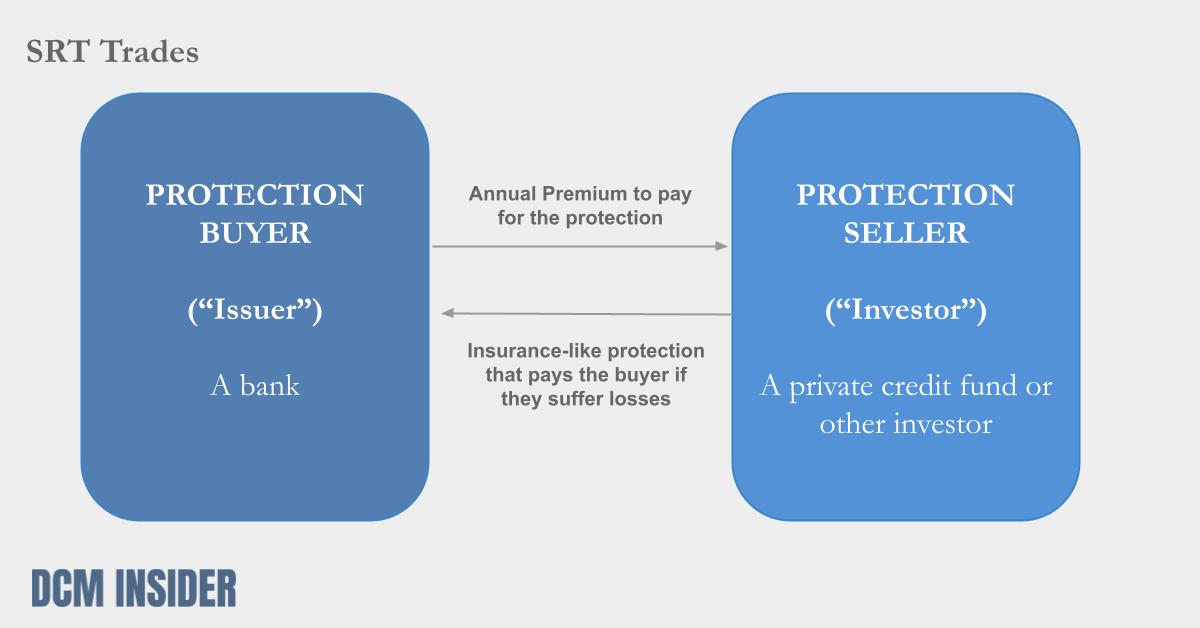
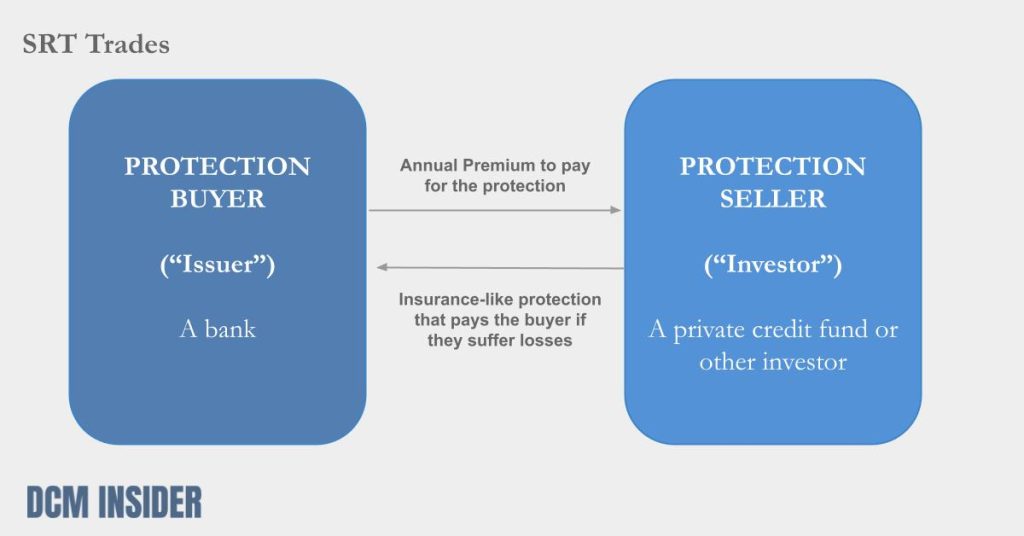
    In short: SRT trades are a way for banks to buy insurance-like protection on some of their assets.

    Who are the parties involved?

    1) A protection buyer: this is usually a bank. This party is also called the issuer.

    2) A protection seller: this is usually a private credit fund, investment bank, insurance company, pension fund, supranational, or hedge fund. This party is also called the investor.

    Why do banks (protection buyers) do these trades?

    The main reason is that it can be profitable – as the amount of regulatory capital that this type of deal frees up can be more expensive to hold than the amount they have to pay for the deal.

    For example, buying protection on a set of assets might cost a bank $3 million per year in premiums that they need to pay to the protection seller; but the bank might save $5 million per year because of the amount of regulatory capital it frees up for the bank.

    Are there other reasons banks might do these trades?

    This is less common – but in some cases banks might have too much of one type of risk and could use an SRT trade to reduce their concentration of that type of risk.

    For example, a specialist bank in Greece might have a lot of exposure to shipping loans relative to its total asset base – and so may enter into an SRT trade wherein they buy protection on some of their shipping loans – and so reduce their total exposure to shipping loans.

    Why do protection sellers (investors) do SRT trades?

    Investors get paid to take the risk.

    Because these trades are relatively complicated to understand and put together, they face less competition than many other types of investment. This creates an opportunity for investors who have the right expertise in their teams. It can allow them to make investments in SRT trades that pay a higher return than other investments with the same level of risk.

    What risks do banks protect against in SRT trades?

    Usually against losses in portfolios of loans that the bank has made to customers – like residential mortgage loans, consumer loans, auto loans, or corporate loans.

    How do investors evaluate the risk they are taking with SRT trades?

    Investors usually put together a model – that tries to estimate the risk of having to make a payment because there have been losses on the assets that the SRT trade protects. They will usually use broad market data (like economic projections) and specific data (like historical default rates and losses that the issuer has experienced on this type of asset).

    What unlocked SRT Trades in the US in 2023?

    Clarification from the US Federal Reserve in their September 2023 FAQs made it clear that these deals work in reducing regulatory capital requirements for banks the US.

    How are SRT deals structured?

    SRT trades are mostly structured as Credit Default Swap (CDS) contracts or Credit Linked Notes (CLNs). In either case the protection buyer gets paid out by the protection seller if there is a loss event on the protected assets.

    The difference is that CDS contracts are usually unfunded and CLNs are funded upfront. Because of this, when a loss event happens, with a CDS the protection buyer needs to ask the protection seller to transfer money to cover the losses; but with a CLN, they just deduct the loss from the money they already hold on behalf of the protection seller.

    CDS can be cheaper, but expose the protection buyer to the credit risk of the protection seller going bankrupt – meaning that CDS can only usually be issued by highly-rated protection sellers. There are also regulatory differences in different jurisdictions that affect exactly how these deals are structured in different markets.

    These deals are usually structured in a way such that there is a cap on the amount of losses that the protection seller will cover. For example, on a $100 million portfolio, the protection might only be for the first $10 million of losses. Similarly, there might be the equivalent of an excess on an insurance policy – where the first losses on the portfolio might have to be borne by the issuer. In our $100m portfolio example, this might be that the first $1 million of losses are not covered. This is referred to as “tranching”. These caps and excess-like provisions are structured on a trade-by-trade basis based on what each party is trying to achieve, regulatory rules in the jurisdiction, and other factors.

  • Buyside: ADIA and MUFG Back AlbaCore’s New European Senior Lending Strategy

    Buyside: ADIA and MUFG Back AlbaCore’s New European Senior Lending Strategy

    ADIA and MUFG Back AlbaCore's New European Senior Lending Strategy

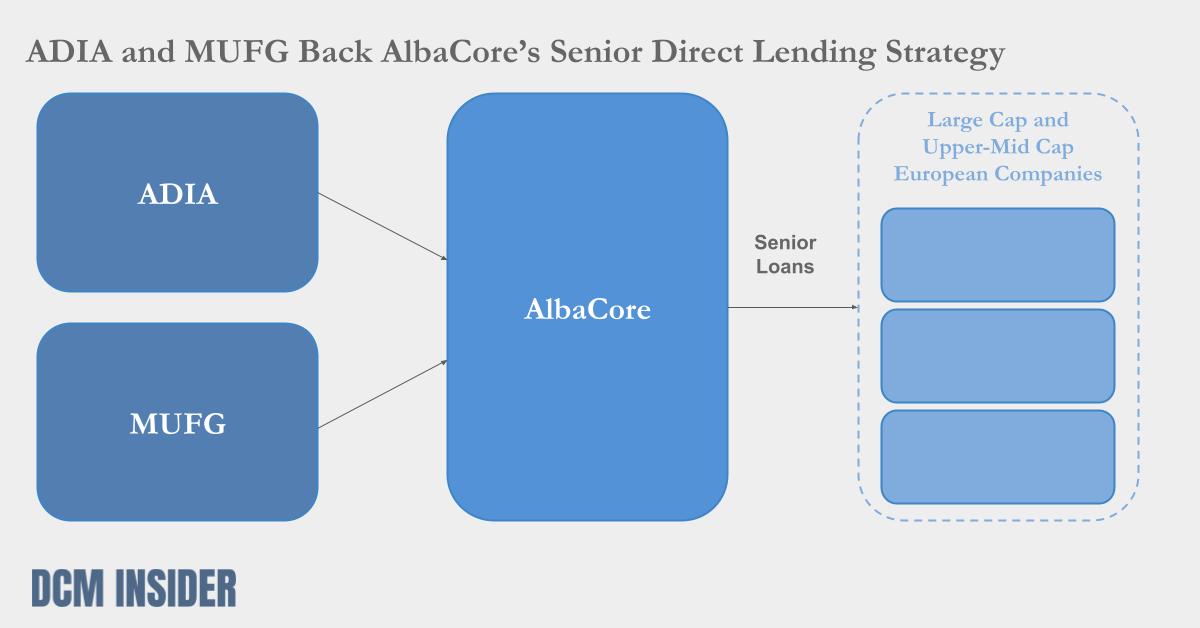
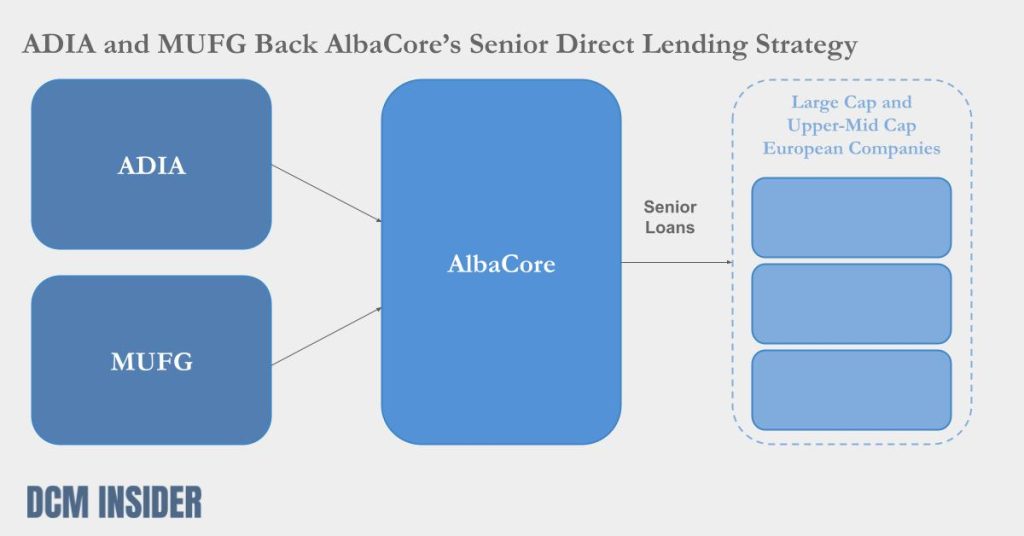
    AlbaCore has launched a new Senior Direct Lending Strategy – that directly lends to large and upper-mid sized companies in Europe.

    The European private credit market is a rapidly growing part of the European debt capital markets.

    This first close gives AlbaCore $1.8 billion of investable capital for this strategy.

    Anchor investors are the Abu Dhabi Investment Authority (ADIA) and Mitsubishi UFJ Financial Group (MUFG).

    AlbaCore is an alternative credit manager with $9.4 billion AUM that invests in private credit, special situations, CLOs, and structured credit.

    AlbaCore, ADIA and MUFG’s Rationale
    Investors see good risk-return opportunities in the senior direct lending space. Managers are in a race to get scale before the market matures.

    Before this type of senior direct lending private credit fund existed, the companies served would borrow from banks – and to a lesser degree from broadly syndicated loans (BSL) and bonds.

    As private credit funds have lower costs than banks, they are able to win deals on price and still end up with good risk-return assets. The lower costs come from lower operating costs, and from not having the regulatory capital requirement costs of banks.

    As the European senior direct lending market is still relatively new, there is currently a race to gain market share. This market share then gives the winners a competitive advantage in the future – both in capital raising and in deploying assets.

    The rationale is borne out in comments on this deal from AlbaCore, ADIA and MUFG:

    AlbaCore’s Managing Partner and Chief Investment Officer, David Allen: “Securing commitments from ADIA and the Trust Bank for the first vintage of our Senior Direct Lending Strategy is a testament to the attractiveness of the opportunity set in the market and how well positioned AlbaCore is to take advantage of it.”

    ADIA’s Hamad Shahwan AlDhaheri, Executive Director of the Private Equities Department: “This anchor commitment presented the opportunity to grow our existing relationship with AlbaCore, which has established itself as a leading specialist European credit manager. AlbaCore’s Senior Direct Lending strategy is well placed to address the significant and growing demand from European corporates for private credit solutions.”

    MUFG’s Chief Executive, Asset Management & Investor Services Business Unit: “We are excited to support the Strategy through this anchor investment. This strategic initiative aligns with that of our global asset management business, which is to expand our private product competitiveness globally in the direct lending space.”

  • US Private Credit Default Rate Up From 5.0% To 5.7%

    US Private Credit Default Rate Up From 5.0% To 5.7%

    US Private Credit Default Rate Up From 5.0% To 5.7%

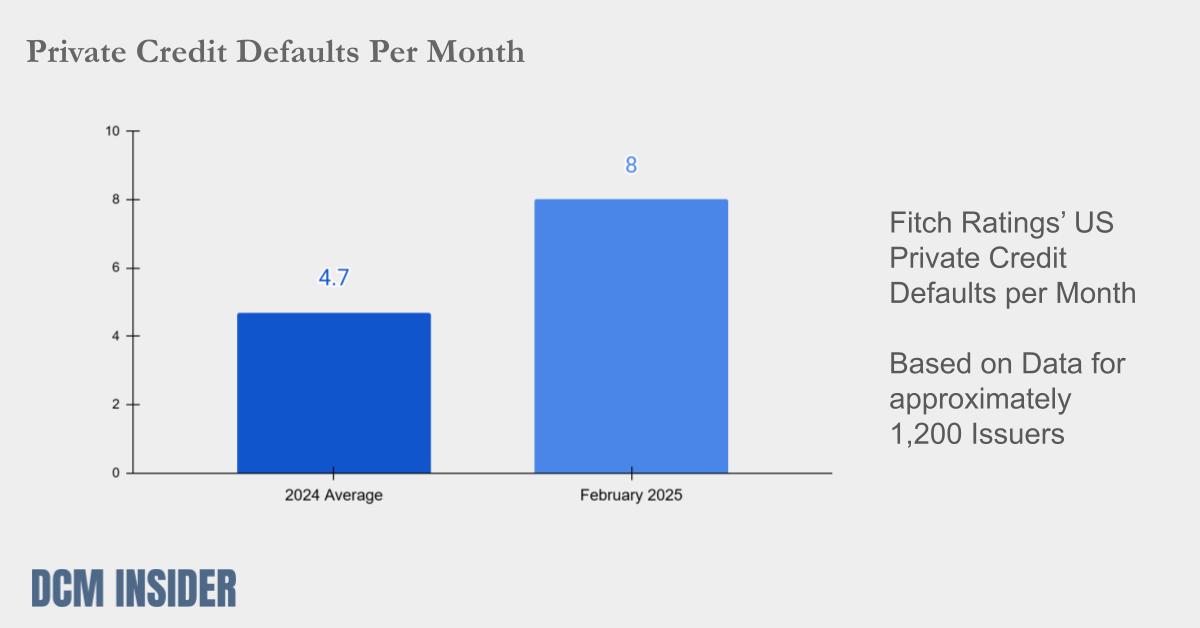
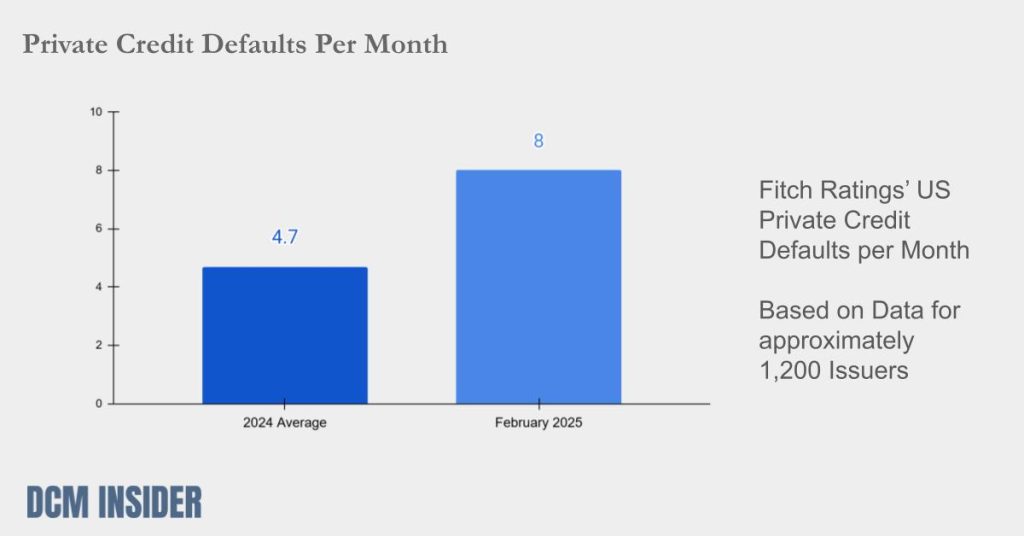
    Fitch Ratings tracks US credit default rates. The rate is 5.7% for the 12 months to the end of February. The same January figure was 5.0%.

    Borrowers who took on private credit debt when interest rates were low have faced much higher interest rates over the last few years – putting pressure on cash flows. For example for 2021-vintage deals, the federal funds rate when the company issued the debt was 0.25%.

    The default statistics are based on data for approximately 1,200 issuers. This breaks down to 300 issuers for which Fitch provides private ratings, and 900 issuers for which Fitch provides credit opinions that feed into mid-market CLO ratings.

    December 2024, January 2025 and February 2025 have each seen 8 defaults. This compares to an average of 4.7 defaults per month for 2024.

    Healthcare had the highest number of defaults – 11 over the 12 months to the end of February. This is out of 150 healthcare issuers.

    Consumer products also showed a high rate of defaults – 5 out of 65 issuers. So 7.6%.

    Fitch’s data is based on the number of defaults and is not weighted by the amount of debt outstanding for each issuer.

    The eight defaults in February were interest deferrals or conversions of cash interest to payment-in-kind.

    The data is lumpy, but it seems to point to an increase in stressed situations in old-vintage private credit deals.

  • Privately-Placed Residual Interest Securitization From CPS

    Privately-Placed Residual Interest Securitization From CPS

    Privately-Placed Residual Interest Securitization From CPS

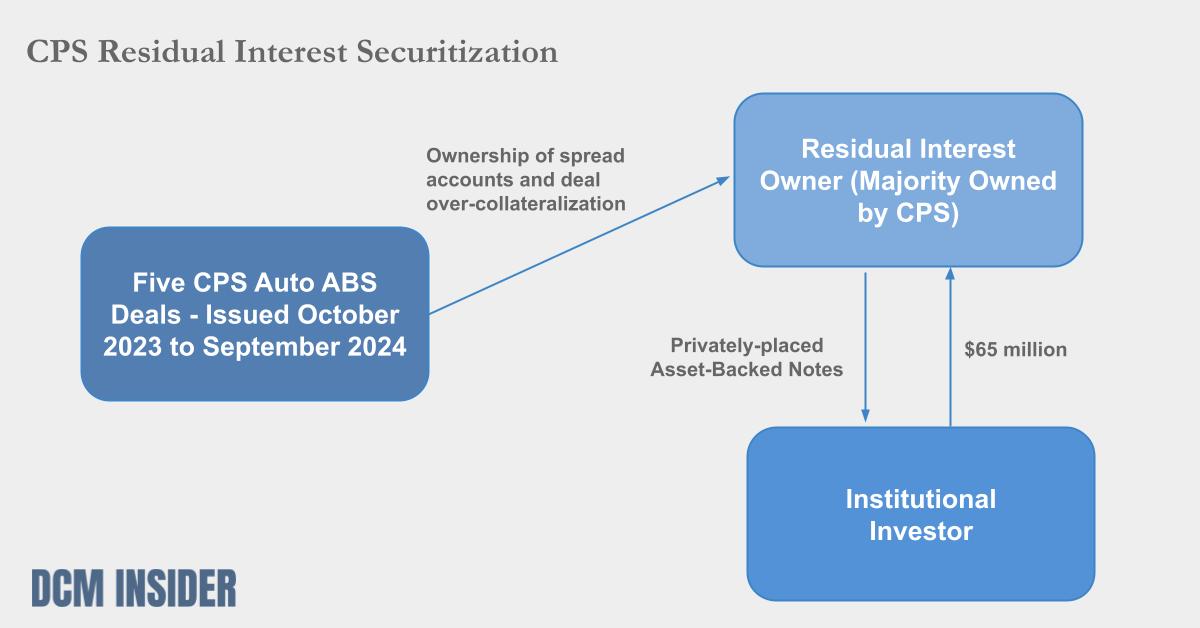
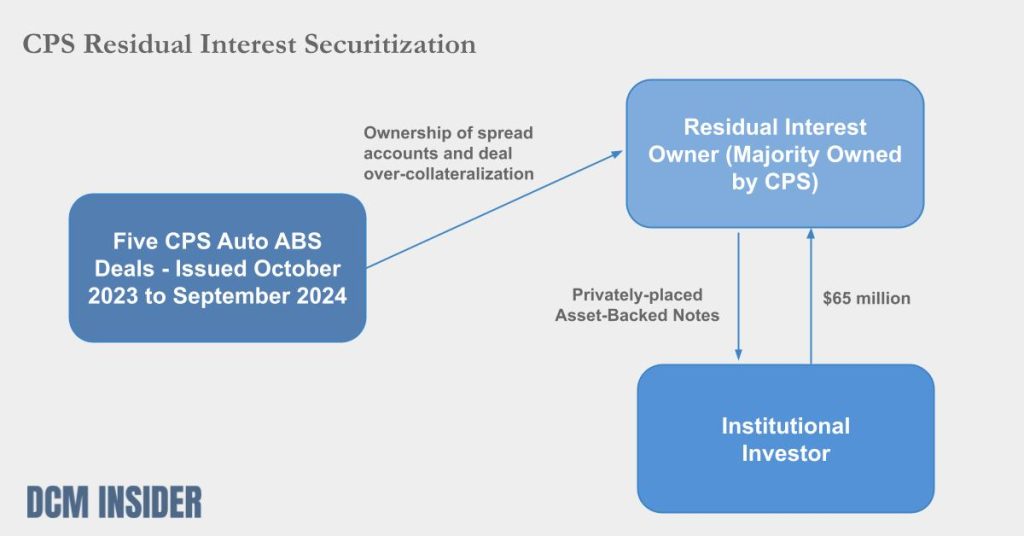
    Consumer Portfolio Services (CPS) has issued a $65m securitization of residual interests from it’s existing securitization (subprime auto loan deal ABS) deals. CPS is based in Las Vegas.

    The deal was bought by a single institution as a privately placed deal. The deal was structured as asset-backed notes.

    The notes are backed by an 80% interest in an entity (“Residual Interest Owner”) that owns the residual interests in five CPS ABS deals issued between October 2023 and September 2024.

    The Residual Interest Owner that backs the deal in turn owns 80% of the deposits in the underlying spread accounts for the CPS deals, as well as 80% of the over-collateralization of each of the five CPS deals.

    This residual interest securitization deal pays interest monthly. It also has a minimum colleralization ratio mechanism – where the notes will pay down principal if needed to maintain the minimum collateralization ratio.

    CPS has issued residual interest securitization deals every years. CPS did a residual interest securitization deal in June 2021. This was a $50m deal – structured as one tranche with a coupon of 7.86%. That deal was issued by CPS Auto Securitization Trust 2021-1.

  • Private Credit – JPMorgan Raises The Bar With $65 Billion Dry Powder

    JPMorgan is to invest $65 billion in private credit – $50 billion from its balance sheet and $15 billion from co-lenders.

    JPMorgan CEO Jamie Dimon has been vocal about the threat to banks from private credit funds. He has spoken about bank capital requirement changes after 2008 making it harder for banks to compete with private credit funds, and problematic accounting (valuation) practices by some private credit funds.

    JPMorgan has invested over $10 billion across more than 100 private credit deals since 2021.

    JPMorgan has an edge over private credit funds – in that it can offer clients direct private credit loans, syndicated loans and bonds – together with ancillary products like derivatives for their transactions. They already have relationships with an enormous client base – banking 80,000 companies globally through their Commercial and Investment Bank, including 32,000 US middle market clients.

    JPMorgan’s difficulty is that bank capital charges for some loans might be high.

    Strategically, it may make sense for JPMorgan to accept higher costs through bank capital charges – to avoid private credit funds from eroding the bank’s market share of being the borrowing solutions provider to companies.

    In a press release, JPMorgan said: “As private credit has grown exponentially to a $2 trillion market, direct lenders are sitting on hundreds of billions of dollars of dry powder to deploy.”. Deployment into good quality assets is becoming more difficult as the number of private credit lenders and the amount of capital that needs to be deployed increase.