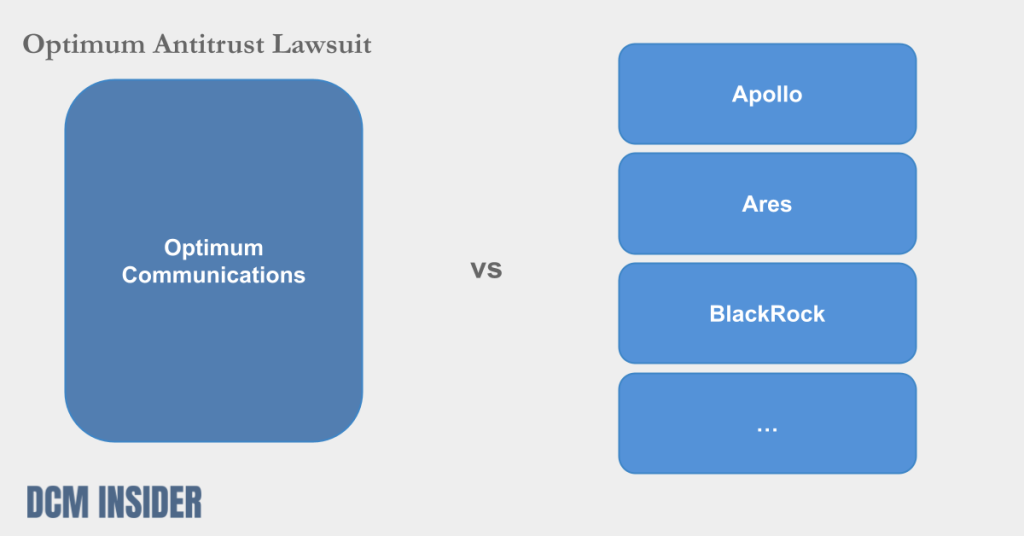
Optimum Communications (formerly Altice) is the fourth largest telecommunications company in the US. It provides cable TV and broadband services to around 4.5 million customers. The company has $25bn+ of debt outstanding across loans, bonds and securitization transactions.
The company filed a lawsuit in November accusing creditors of forming a cartel by entering into a cooperation agreement which the company says has effectively locked it out of the leveraged finance market and has prevented it from running liability management transactions.
The creditors in the lawsuit are Apollo, Ares, BlackRock, GoldenTree, JP Morgan, Loomis Sayles, Oaktree and PGIM.
The cooperation, among other things, prevents creditors from negotiating individually with Optimum, and requires a two-thirds supermajority for group decisions.
The debt investors have asked the judge to dismiss the lawsuit – on the grounds that this is not an antitrust situation – including that they promote competition, reduce transaction costs, and prevent creditor-on-creditor opportunism.
This potential for this type of “creditor-on-creditor violence” situation has grown with the private credit markets. This type of situation is less likely with bank loan/syndicated loan debt and with broadly-owned public bond debt. As the private credit markets at their current scale are also quite new, structural features like covenant packages are still evolving and are likely lighter than ideal in many deals.
Why this matters – the precedent set in this transaction will affect the relative power of creditors and issuers in stressed situations. This will in turn affect the price and structuring (covenants, formats, private vs public deals, asset-backed vs unsecured, etc.) of sub-investment-grade debt.
Advertisement